

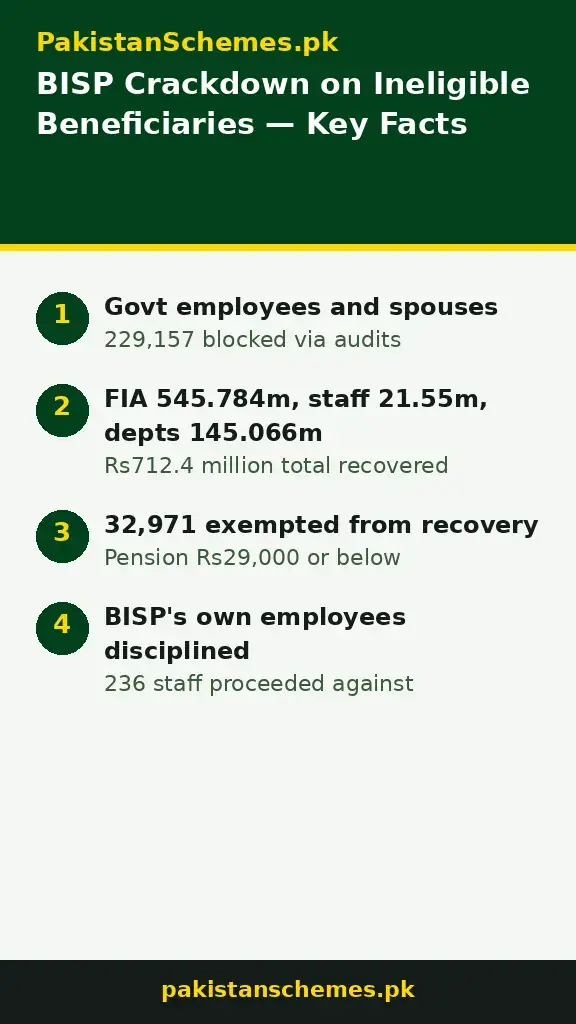
The Benazir Income Support Programme (BISP) has blocked 229,157 government employees or their spouses from receiving financial assistance, after audits identified them as ineligible beneficiaries. The government has also recovered Rs712.4 million from ineligible recipients — the details were shared by the Minister for Poverty Alleviation and Social Safety, Syed Imran Ahmad Shah, in a written reply to a parliamentary question.
According to the reply, the recovered amount is split three ways: Rs545.784 million through the Federal Investigation Agency (FIA), Rs21.550 million from BISP’s own employees, and Rs145.066 million from other government departments. Recovery proceedings have also been initiated against 236 BISP employees, with disciplinary action taken against delinquent officials.
This guide explains exactly what the government confirmed, the breakdown of the recovery, who was exempted (and why), how the profiling of over six million records works, and what the crackdown means for genuine BISP beneficiaries who are worried about their payments.
This is an independent informational guide based on the minister’s written reply to Parliament as reported on Friday, 23 October 2026 — not an official BISP announcement. The exercise is ongoing and figures may change. Verify your own beneficiary status only through official BISP channels (8171 SMS or bisp.gov.pk).
Quick Summary
| Topic | Details |
|---|---|
| Action | BISP blocks 229,157 government employees or their spouses from receiving financial assistance |
| Announced | Friday, 23 October 2026 — written reply to a parliamentary question by Minister Syed Imran Ahmad Shah |
| Total recovered | Rs712.4 million |
| Recovery via FIA | Rs545.784 million |
| Recovered from BISP employees | Rs21.550 million |
| Recovered from other departments | Rs145.066 million |
| BISP employees proceeded against | 236 (disciplinary action against delinquent officials) |
| Records profiled | Over 6 million forwarded for profiling and further action |
| Exemption | 32,971 cases exempted from recovery — monthly pension Rs29,000 or below (BISP Board decision) |
| Status | Ongoing — numbers may change as the exercise progresses |
What exactly happened
BISP identified 229,157 government employees or their spouses who were receiving programme financial assistance despite being ineligible, and blocked them. The identification came through audits conducted against programme records, cross-checking beneficiary data with government payroll information.
The updated data of government employees and pensioners was obtained from the Controller General of Accounts (CGA), ministries, autonomous bodies and state-owned enterprises (SOEs). More than six million records were forwarded for profiling and further action — so the 229,157 blocked cases are the result so far, and the minister warned that the number of irregular or ineligible beneficiaries — and the recoverable amount — could change as the exercise progresses.
The minister’s written reply framed this as a continuing clean-up of the beneficiary rolls: data updating, profiling, blocking and recovery all continue side by side.
The Rs712.4 million recovery — full breakdown
The government reported recovering a total of Rs712.4 million from ineligible recipients. Here is exactly how that figure is composed:
| Recovery channel | Amount recovered |
|---|---|
| Through the Federal Investigation Agency (FIA) | Rs545.784 million |
| From BISP’s own employees | Rs21.550 million |
| From other government departments | Rs145.066 million |
| Total | Rs712.4 million |
The figures are as stated in the minister’s reply. The FIA channel accounts for the largest share — over three-quarters of the total — which suggests most of the recovered money was pursued through formal investigation proceedings rather than voluntary return.
Why 32,971 cases were exempted from recovery
Not all of the blocked cases face recovery. According to the reply, 32,971 of the 229,157 blocked cases — involving government employees or their spouses — were exempted from the recovery process because their monthly pension was Rs29,000 or below.
This exemption follows a decision of the BISP Board: pensioners living on Rs29,000 a month or less are treated as financially vulnerable enough that the programme does not pursue recovery from them, even though the employees-and-spouses rule otherwise blocks them from the rolls.
If you or your spouse are in this category, remember that exemption from recovery is not the same as restoration of eligibility — the reply describes them as “exempted from recovery,” and the blocking stands unless the board decides otherwise.
Action against BISP’s own staff
The clean-up is not limited to outside employees. Recovery proceedings have been initiated against 236 BISP employees, with disciplinary action taken against delinquent officials, the minister said. These are cases where the programme’s own staff were found to be involved in irregularities — a significant admission, since insiders exploiting the system is one of the fastest ways benefits leak to the wrong hands.
The reply did not name the officials or detail the specific disciplinary outcomes, so those details remain unverified at this stage.
Crackdown on illegal deductions and agent malpractice
The parliamentary question also raised concerns about illegal deductions, unauthorised charges, fraudulent biometric verification and other malpractices in BISP payments — the complaints beneficiaries report most often. The minister’s response:
- Complaints are examined individually, and action is taken under the applicable rules.
- Cases involving banks and payment service providers are referred to the relevant institutions for investigation and resolution. Depending on findings, corrective measures can include penalties, recovery of irregular amounts and other action against those responsible.
- Legal or disciplinary proceedings are initiated where fraud or serious malpractice warrants it, to safeguard beneficiaries’ payments.
- Agents can be suspended or blacklisted — BISP currently disburses through the retail networks of six partner financial institutions (PFIs), monitored through field visits, beneficiary complaints, system-based controls, inspections and audits. Where irregularities are detected, action can include suspension or blacklisting of agents, recovery of amounts and penalties under contractual provisions.
What the reply did not provide: the consolidated number of bank branches, campsites, agents, point-of-sale (POS) agents and ATMs involved in disbursement, or the total number of agents suspended, blacklisted or proceeded against. The bank-wise and province-wise details were referred to an annexure that has not been published with the reply.
Digital wallets: the plan to cut out middlemen
The government said BISP is gradually shifting towards digital and direct payment mechanisms through Social Protection Wallets (SPWs) to reduce human intervention and beneficiaries’ dependence on intermediaries. The initiative aims to give beneficiaries greater choice, transparency, convenience and security — and to ensure they receive the full amount sanctioned under the programme.
The minister also confirmed that BISP has developed and implemented an Integrated Grievance Management System (IGMS), integrated with the partner financial institutions, to streamline complaint handling and improve transparency and payment security within the State Bank of Pakistan’s regulatory framework. Further development of the grievance system will be undertaken gradually as needed.
What this means for genuine BISP beneficiaries
- If neither you nor your spouse is a government employee, this crackdown does not affect you. Your payments continue as normal.
- Check your status only through official channels — SMS 8171 or the official bisp.gov.pk website. Do not trust anyone who claims they can “confirm” or “restore” your eligibility for a fee.
- If an agent deducts money from your payment, that is illegal — report it. The reply confirms complaints are examined individually and agents can be suspended or blacklisted.
- Keep your CNIC and payment records safe. During verification exercises, programme staff may need your documents — but genuine BISP staff will never ask for your bank PIN or wallet passwords.
- Watch out for new scams. News of crackdowns is routinely exploited by fraudsters who call beneficiaries claiming their payment is “blocked” and demanding money to unblock it. BISP does not work this way.
Frequently Asked Questions
Why were 229,157 people blocked from BISP?
They were identified as government employees or their spouses through audits and data cross-checking with the Controller General of Accounts, ministries, autonomous bodies and state-owned enterprises. Government employees and their spouses are ineligible for BISP financial assistance.
How much money has been recovered?
Rs712.4 million in total: Rs545.784 million through the FIA, Rs21.550 million from BISP employees, and Rs145.066 million from other government departments.
Who is exempt from the recovery?
32,971 blocked cases where the monthly pension is Rs29,000 or below — exempted from recovery under a BISP Board decision. This is an exemption from recovery, not a restoration of eligibility.
Is this exercise finished?
No. The minister said the process of data updating, profiling, blocking and recovery is continuing, and the numbers may change as it progresses.
How do I check if my BISP payment is affected?
Send your CNIC number by SMS to 8171 or check the official BISP website. Never pay anyone who offers to “check” or “fix” your status.
What if an agent takes a cut from my payment?
Report it through the BISP grievance system — complaints are examined individually, and agents found guilty can be suspended or blacklisted.
Related on PakistanSchemes: BISP program online registration — the complete 2026 guide



1 thought on “BISP Blocks 229,157 Government Employees From Aid, Recovers Rs712 Million”