The Board of Intermediate Education Karachi (BIEK) has announced the results of the 2026 annual examinations for first-year intermediate (HSC Part-I) students in the pre-medical, general science, commerce, arts, special candidates and home economics groups. The announcement, made on Monday, 26 October 2026 and reported the following day, matters to tens of thousands of Karachi students because it is the first BIEK first-year result issued under a new grading system.
Under the new system, a student must secure at least 40% marks in each paper to pass that paper. Anyone scoring less than 40% in a paper is classified as “ungraded” in that subject and is considered unsuccessful in it. That single change is the most important thing to understand before reading your own result, because a result that looks like a pass in some papers can still leave a paper to be retaken.
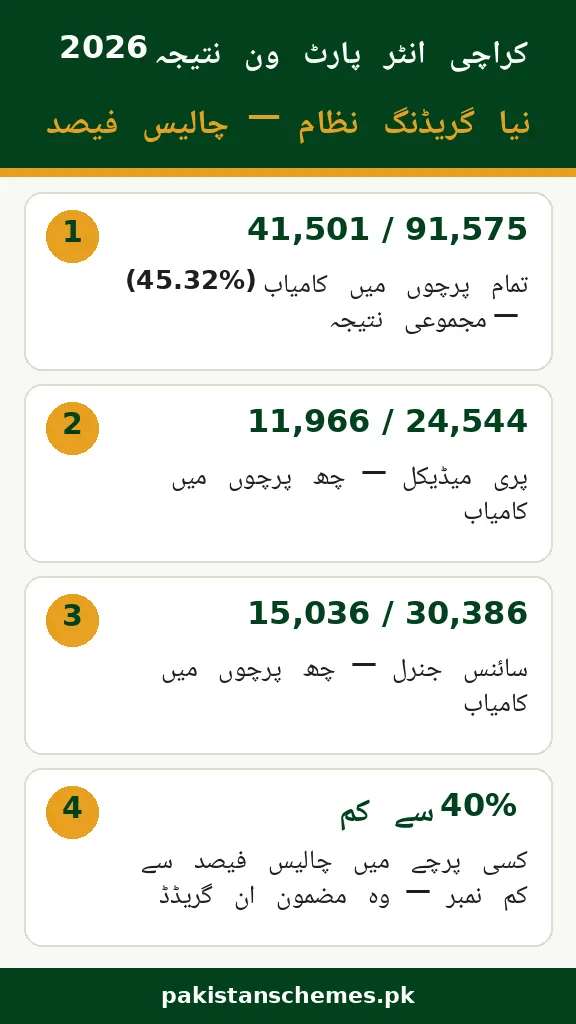
Across the eight groups covered in this announcement, 94,300 candidates registered and 91,575 appeared. Of those who appeared, 41,501 passed all of their papers. The sections below set out the group-wise figures released by the board, explain the new grading rule in plain language, and show how to check your result through the board’s own channels.
Quick Summary
| Topic | Details |
|---|---|
| Board | Board of Intermediate Education Karachi (BIEK) |
| Examination | HSC Part-I (11th Class / 1st Year) Annual Examinations 2026 |
| Result announced | 26 October 2026 (reported 27 October 2026) |
| Groups announced | Pre-Medical, Science General, Commerce Regular, Commerce Private, Arts Regular, Arts Private, Special Candidates (Arts Regular), Home Economics |
| Groups not in this announcement | Pre-Engineering — announced earlier, on 2 October 2026 |
| Candidates registered | 94,300 (all eight groups combined, calculated from the board’s group figures) |
| Candidates appeared | 91,575 |
| Candidates who passed all papers | 41,501 |
| New grading rule | At least 40% marks in each paper to pass; below 40% in a paper means “ungraded” in that subject |
| How to check | Board website biek.edu.pk and the board’s official Android app (search for “BIEK”) |
| SMS code | No SMS code was stated in the board announcement as reported — do not rely on a forwarded code unless BIEK confirms it |
| Official source | Board of Intermediate Education Karachi (BIEK); figures as reported by the Controller of Examinations |
How to Check the BIEK Karachi Inter Part-I Result 2026
1. Check on the board website
The board’s official website is biek.edu.pk. Reports of the announcement say students can check their results through the board’s official website and its Android application. Use only the board’s own website for your result, and take care to open the result for the correct examination and group.
- Open biek.edu.pk on your phone or computer.
- Go to the Results section.
- Select HSC Part-I Annual Examinations 2026 and then your group — for example, Science Pre-Medical, Science General, Commerce Regular, Arts Regular or Home Economics.
- Enter your roll number exactly as printed on your roll number slip, if the page asks for it, or open the result gazette for your group if that is how the board has published it.
- Check your name, roll number and subject-wise result carefully before you share or print anything.
Board websites are often slow in the first hours after a result is announced because so many students try to check at the same time. If the page does not load, wait a few minutes and try again rather than refreshing again and again. Save a screenshot or a copy of your online result for your own record, but remember that the online copy is not a substitute for the official marks sheet the board issues.
2. Check on the board’s Android app
Reports of this announcement also say the result can be checked through the board’s official Android application. Search for “BIEK” on the Google Play Store and install only the board’s official app. Do not install apps that claim to show BIEK results but ask for extra personal details, payments or permissions that have nothing to do with checking a result.
3. Check through your college
If the website and the app are both unreachable, your college is the next reliable place to ask. Colleges receive result information from the board and can guide students on what a particular result entry means. Take your roll number slip with you, and ask the college office rather than relying on a screenshot forwarded in a class group.
What the New Grading System Means
The new grading system was introduced for the 2026 first-year annual examinations. The board’s own statement, as reported, is short and clear: candidates must secure at least 40% marks in each paper to pass, and candidates scoring less than 40% in any paper will be classified as “ungraded” and considered unsuccessful in that subject.
In practice, that means the result is judged paper by paper, not only on a total. A student can do well in most papers and still have one paper marked ungraded. That paper has not been passed, and the student will need to reappear in it, subject to the board’s examination requirements. Reports of the announcement describe the change as a decision of the Inter Board Coordination Commission (IBCC) and the Sindh government’s Universities and Boards Department; that is the background given in news reports of the announcement, and students who need the formal wording should read the board’s own notification.
Two common misunderstandings are worth avoiding. First, “ungraded” is not a grade for the whole result — it applies to the individual paper in which the marks fell below 40%. Second, passing all papers and passing some papers are different outcomes in the board’s figures. The table in the next section counts only students who passed all of their papers, which is why those numbers are lower than the number of students who passed at least one paper. Do not compare the “passed all papers” figure with a total pass figure from another board unless you are sure both figures count the same thing.
Group-Wise Results: Who Passed All Papers
The figures below were released by the board through the Controller of Examinations, Zarina Rashid, and reported identically in the main news reports of the announcement. The pass percentages in the last column have been calculated from the board’s registered, appeared and passed figures for each group.
| Group | Registered | Appeared | Passed all papers | Passed all papers (%) |
|---|---|---|---|---|
| Pre-Medical | 25,157 | 24,544 | 11,966 | 48.75% |
| Science General | 30,991 | 30,386 | 15,036 | 49.48% |
| Commerce Regular | 23,549 | 22,693 | 9,332 | 41.12% |
| Commerce Private | 1,485 | 1,413 | 628 | 44.44% |
| Arts Regular | 11,171 | 10,678 | 3,748 | 35.10% |
| Arts Private | 1,702 | 1,623 | 692 | 42.64% |
| Special Candidates (Arts Regular) | 99 | 97 | 58 | 59.79% |
| Home Economics | 146 | 141 | 41 | 29.08% |
| All eight groups | 94,300 | 91,575 | 41,501 | 45.32% |
The figures also show how many papers each group had to clear. Pre-medical, science general and both arts groups are counted over six papers, while both commerce groups and home economics are counted over seven papers. That difference matters when you compare groups: a commerce or home economics student had one more paper in which to fall below the 40% line.
What the Figures Tell Students
Science general had the largest entry of any group in this announcement, with 30,991 registered candidates, and just under half of those who appeared — 49.48% — passed all six papers. Pre-medical, the group most students associate with medical college entry, was close behind at 48.75%. Neither figure is a whole-result pass rate in the older sense of the word; both count only students who cleared every paper under the new 40% rule.
Commerce regular recorded the lowest pass-all-papers rate among the large groups, at 41.12%, even though commerce private candidates, a much smaller group, recorded 44.44%. Arts regular recorded 35.10%, the lowest rate among the large groups, while arts private candidates recorded 42.64%. The gap between regular and private candidates in both commerce and arts is a pattern worth noting, but the announcement itself does not explain it, and no single cause should be read into the numbers.
The two smallest groups need the most care when reading their percentages. Only 97 special candidates appeared, so their 59.79% rate moves sharply with a handful of results either way. Only 141 home economics candidates appeared, so the 29.08% rate for that group — 41 students passing all seven papers — describes a very small cohort and should not be compared directly with a group of 30,000 students. Small groups tell you what happened to those students; they do not tell you how hard the papers were in general.
The board also said that electronic assessment was used for all optional subjects in the science groups, using modern Optical Mark Recognition (OMR) and electronic marking systems. That is a statement about how those papers were marked, not a statement about any individual student’s marks. If you believe a marking error has affected your own result, the route is the board’s own scrutiny or rechecking process — not a social media post or a paid agent.
If You Did Not Pass All Papers: What Happens Next
First, read the result paper by paper. Find out exactly which papers, if any, are marked ungraded, and which papers you have passed. That distinction decides what you need to do next, and it is easy to miss when you only look at a headline or a forwarded summary.
Second, do not assume a date, a fee or a form from another board or another year. The announcement as reported does not state a supplementary examination date, a rechecking fee or a last date for applications. Those details are set by BIEK in its own notifications, and they can differ from the Punjab boards or from last year’s Karachi schedule. Check biek.edu.pk or ask your college office for the current notification before you pay anyone or fill in any form.
Third, keep your documents together: your roll number slip, a copy of your online result, and any notice your college gives you. If you apply for scrutiny of an answer book or for reappearing in a paper, you will need the exact roll number and group details, and having them ready will save repeated visits. If a paper is marked ungraded, plan your preparation around that subject specifically, rather than re-studying everything at the same level.
Finally, remember that first year is only half of the intermediate course. Students who clear their remaining papers go on to second year on the strength of the full two-year result. A setback in one paper in Part-I is serious, but it is a defined, fixable problem with a defined route back — provided you follow the board’s own timetable.
Pre-Engineering Students: A Separate, Earlier Result
Pre-engineering students are not covered by this announcement because their Part-I result was announced earlier, on 2 October 2026. If you are a pre-engineering student and you are reading this article looking for your result, do not use the figures above — they belong to other groups. Check the pre-engineering result through the same board channels, biek.edu.pk and the official BIEK app, selecting the pre-engineering group.
Before You Trust a Forwarded Result Link
Result days bring a wave of forwarded messages, and not all of them are honest. Be careful with any message that asks you to pay for your result, asks for your CNIC number, your parents’ CNIC, a bank detail or an OTP, or promises to change your marks. BIEK does not need your CNIC or a payment to show you a result on its own website, and no agent can change a board result for money.
Use only biek.edu.pk and the official BIEK app. If a link takes you to a page full of advertisements with no clear connection to the board, close it. If a message claims an SMS code for this result, treat it with caution: no SMS code was stated in the announcement as reported, and codes used by other boards or in other years do not automatically apply to BIEK. When in doubt, ask your college office or check the board website directly.
Frequently Asked Questions
Has the BIEK Karachi Inter Part-I result 2026 been announced?
Yes. The Board of Intermediate Education Karachi announced the 2026 annual examination results for first-year students in the pre-medical, general science, commerce, arts, special candidates and home economics groups on 26 October 2026. Pre-engineering had been announced earlier, on 2 October 2026.
What does “ungraded” mean in the new grading system?
It means the candidate scored less than 40% marks in that paper. Under the new system, at least 40% in each paper is needed to pass it, so a paper marked ungraded counts as unsuccessful in that subject. The student will need to reappear in that paper, subject to the board’s requirements.
How do I check my BIEK Part-I result?
Through the board’s official website, biek.edu.pk, or the board’s official Android app — search for “BIEK” on the Google Play Store. Select HSC Part-I Annual Examinations 2026 and your group, and enter your roll number if asked, or check the gazette for your group. Your college office can also help.
Is there an SMS code to check the Karachi board result?
No SMS code was stated in the announcement as reported. Do not send your roll number to a code forwarded on social media unless BIEK itself confirms that code for this result.
What was the overall result?
Across the eight groups in this announcement, 91,575 candidates appeared and 41,501 passed all of their papers — 45.32%, calculated from the board’s group figures. Group rates ranged from 29.08% in home economics (a cohort of only 141 appeared candidates) to 59.79% among special candidates (97 appeared).
What should I do if I failed or was marked ungraded in a paper?
First, confirm exactly which papers are affected. Then check the board’s own notification for the supplementary examination and scrutiny process, including dates and fees, and follow it through your college or the board website. Do not rely on dates or fees from other boards, other years or forwarded messages.
Sources and Verification Note
This article is based on the Board of Intermediate Education Karachi announcement as reported by the Express Tribune on 27 October 2026, with the same group figures and the same account of the new grading system also reported by The Destination, citing 24NewsHD. The pass percentages shown are calculated from the board’s published group figures, and the result date of 26 October 2026 is the date given in the other news reports of the announcement. No SMS code, supplementary date, rechecking fee or grade scale has been added where the announcement as reported did not state one. Readers should confirm the current position on biek.edu.pk before acting on any date or fee, because board notifications can change after the announcement.
PakistanSchemes.pk is not a government website. This article is for information only. Always verify result details with the Board of Intermediate Education Karachi.