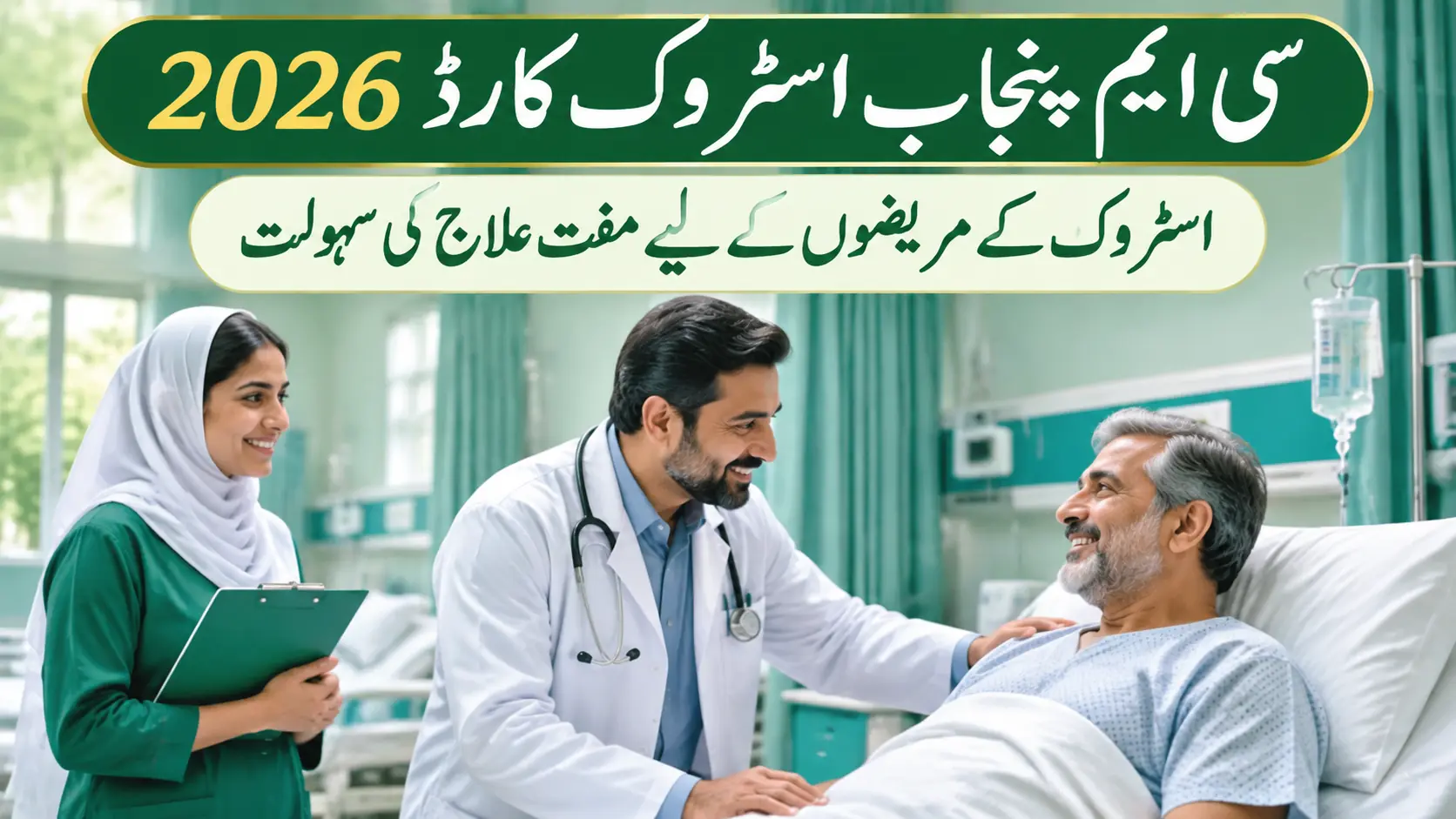
The Punjab government has introduced Stroke Cards as part of its efforts to improve emergency treatment for stroke patients. Chief Minister Maryam Nawaz Sharif distributed Stroke Cards at Lahore General Hospital on October 29, 2026, according to published reports. The announcement comes as Punjab expands its existing Chief Minister Stroke Programme. The province now reports 40 operational stroke centres, and the government has announced additional funding for stroke treatment. However, some important information is still missing. Detailed official eligibility criteria, registration procedures and card benefits have not yet been published in the information reviewed. This guide explains what is known about the CM Punjab Stroke Card 2026, where stroke treatment is available and what readers should do before trusting unofficial registration claims.
What Is the CM Punjab Stroke Card 2026?
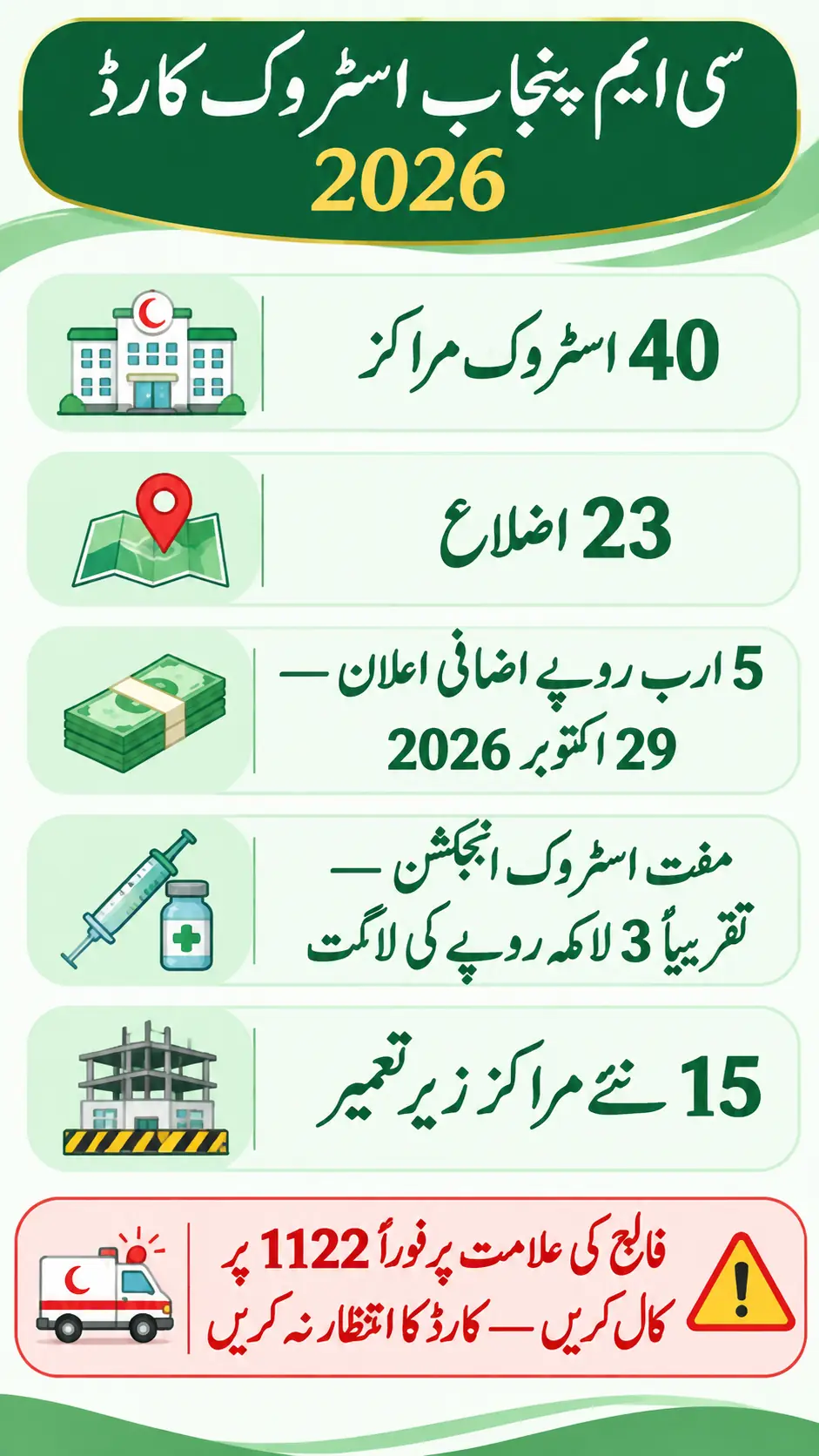
The CM Punjab Stroke Card 2026 is associated with the Punjab government’s existing Chief Minister Stroke Programme. Chief Minister Maryam Nawaz Sharif distributed Stroke Cards during a ceremony at Lahore General Hospital on October 29, 2026, according to published reports. The existing programme focuses on emergency stroke management, specialised treatment facilities and timely care for stroke patients. The Punjab government has also announced an expansion of its stroke treatment network from 16 to 40 centres.
What is not yet officially explained? Although card distribution has been reported, detailed official instructions explaining how the new card works have not been located. The following information remains unconfirmed: whether the card is available to every Punjab resident; whether it is restricted to patients from low-income families; whether it provides a specific financial treatment limit; whether it covers all hospital expenses; whether it works as a health insurance card or another form of treatment documentation; and whether patients can use it at every government hospital. Therefore, patients should not assume that receiving a Stroke Card automatically guarantees unlimited free treatment.
Who Qualifies for the CM Punjab Stroke Card 2026 and How to Get One?
Eligibility and registration are among the most important questions for people interested in the CM Punjab Stroke Card 2026. The chief minister’s wider stroke programme has been described as serving the general public. However, no detailed official eligibility rules have been published in the material reviewed.
Who can receive the Stroke Card? The available announcements identify stroke patients and the general public as the intended beneficiaries of the wider programme. However, the following eligibility details have not been officially established: Is it available to all Punjab residents? — Not officially confirmed. Is there an income limit? — Not announced. Is there an age restriction? — Not announced. Is Punjab domicile compulsory? — Not confirmed. Is CNIC registration required? — Not confirmed. Is BISP registration required? — No official evidence found. Is PSER registration required? — No official evidence found. Is a medical assessment required for card issuance? — Not established. Until the government publishes formal instructions, readers should avoid relying on unofficial eligibility claims.
How can you apply for the CM Punjab Stroke Card? No verified general application procedure has been identified in the available official information. In particular: no verified online registration portal has been identified; no official SMS registration code has been verified; no general hospital-based application procedure has been published; no confirmed document checklist is available; and no official application deadline has been established. The initial distribution of cards at Lahore General Hospital does not mean that all patients can automatically collect a card there. People interested in the programme should wait for an official announcement from the Punjab government or the Specialized Healthcare and Medical Education Department. Do not submit personal information through unofficial registration forms or pay anyone claiming to arrange a card.
Punjab’s 40 Stroke Centres Across 23 Districts
The Punjab government has expanded its existing stroke treatment network to 40 operational centres. According to the October 29, 2026 announcement, these centres provide access to specialised stroke treatment across the province. The reported breakdown is 38 primary stroke centres and two comprehensive stroke centres (Primary stroke centres: 38; Comprehensive stroke centres: 2; Total operational centres: 40). The distinction is important because primary and comprehensive centres have different roles within the treatment network. The government has also announced plans to establish 15 additional stroke centres. These are additional centres under development, not operational facilities.
Which hospitals provide comprehensive stroke care? The two reported comprehensive stroke centres are: 1. Punjab Institute of Neurosciences (PINS), Lahore. 2. Rawalpindi Institute of Cardiology, Rawalpindi. The wider network also includes primary stroke treatment facilities at government hospitals.
Are the 40 centres located across 23 districts? The October 29 announcement reported that 40 operational centres were serving 23 districts. However, a complete, updated official directory identifying all 40 hospitals and their districts has not been located. Patients should confirm the availability of stroke treatment at their nearest designated facility before travelling. Important: the 40-centre treatment network does not automatically mean that every centre issues or accepts the Stroke Card.
What Treatment Does the CM Punjab Stroke Programme Cover?
Punjab’s existing Chief Minister Stroke Programme focuses on improving access to emergency stroke treatment. One of its reported services is the provision of free Tenecteplase (TNK) injections for eligible patients. However, the existing programme’s treatment services should not be confused with a complete list of Stroke Card benefits.
Free TNK injection for eligible stroke patients: Tenecteplase, commonly called TNK, is a clot-busting medicine used for certain patients experiencing an acute ischemic stroke. An ischemic stroke occurs when a blood clot blocks blood flow to part of the brain. Timely medical assessment is essential because eligible patients may benefit from clot-busting treatment only within a limited time after symptoms begin. Earlier reporting in January and February 2026 confirmed that free TNK treatment was being provided under the existing stroke programme. This is important because the medicine can be expensive for families who have to arrange emergency treatment privately.
How much does a stroke emergency injection cost? The TNK injection was reported to cost approximately Rs300,000 during the October 2026 announcement. Earlier reporting in February 2026 gave a higher estimated range of Rs350,000 to Rs400,000. (October 2026: Approximately Rs300,000; February 2026: Rs350,000–400,000.) These figures are reported estimates rather than a confirmed fixed retail price. The high cost of emergency treatment has been identified as one reason why the government is supporting free treatment under the programme.
Does the Stroke Card cover all hospital expenses? This is an important question that still needs an official answer. The government has not published a complete Stroke Card benefits schedule in the official information reviewed. Free TNK injection — Reported under the existing programme. Emergency stroke treatment — Part of the existing programme. Specialist stroke care — Supported by programme information. CT and MRI scans — Card-specific coverage not confirmed. Surgery — Card-specific coverage not confirmed. Other medicines — Complete coverage not confirmed. Physiotherapy and rehabilitation — Wider programme support reported; card coverage unconfirmed. Private hospital expenses — Not confirmed. Long-term treatment expenses — Not confirmed. Patients should not assume that the Stroke Card covers every medicine, scan, operation or rehabilitation expense. The government needs to publish the complete benefit details so patients and families can understand what the card covers.
Rs5 Billion Additional Funding for Stroke Treatment
The Punjab government’s October 2026 funding announcement is another important development in the expansion of stroke care. On October 29, Chief Minister Maryam Nawaz reportedly announced an additional Rs5 billion for stroke treatment. ARY News, Dawn and The News reported this announcement. The chief minister also directed that stroke patients should not have their treatment interrupted because of a shortage of funds.
What about the earlier Rs1.2 billion and Rs3 billion figures? There have been earlier financial announcements concerning Punjab’s stroke treatment initiative. These figures belong to different reporting periods and should not be treated as one combined allocation. (Rs1.2 billion — January 2026 — Earlier annual free-treatment estimate; More than Rs3 billion — February and September 2026 — Annual free-treatment figure reported by the Health Minister; Additional Rs5 billion — October 29, 2026 — New funding announcement for stroke treatment.) In January 2026, reports described an annual free-treatment provision of approximately Rs1.2 billion. In February 2026, Health Minister Khawaja Salman Rafique was reported as saying that free treatment facilities worth more than Rs3 billion would be provided annually. The same annual figure was reported again in September 2026. The October 29 announcement of an additional Rs5 billion is a later development. However, the exact accounting relationship between the earlier annual figures and the October announcement remains unclear. There was also separate reporting on October 29 that the chief minister directed the release of withheld PINS funds and an additional Rs5 billion for PINS operational expenditure. It is not clear whether this PINS operational funding report describes the same Rs5 billion announcement or a separate financial decision. Therefore, the figures should not be added together or presented as a confirmed cumulative Stroke Card allocation. The actual disbursement status and detailed financial breakdown also remain unverified.
Stroke Warning Signs and Why Timely Treatment Matters
A stroke is a medical emergency. Getting professional medical assistance quickly can make an important difference to recovery. A stroke occurs when blood flow to part of the brain is interrupted or when a blood vessel in the brain bursts. Common warning signs include: sudden weakness or numbness in the face, arm or leg, especially on one side of the body; sudden difficulty speaking or understanding speech; sudden blurred vision or loss of vision; sudden dizziness, difficulty walking or loss of balance; and a sudden severe headache without an obvious cause.
Remember the FAST stroke warning signs: The FAST method helps people recognise common stroke symptoms. F – Face: one side of the face may droop. A – Arms: one arm may become weak or difficult to raise. S – Speech: speech may become unclear or difficult to understand. T – Time: seek emergency medical assistance immediately. If someone develops these symptoms, do not wait to see whether they disappear. Call Rescue 1122 or seek immediate emergency hospital care.
Why should patients not wait for a Stroke Card? Some eligible patients with acute ischemic stroke may benefit from clot-busting treatment such as TNK. However, this treatment requires prompt medical assessment. Waiting for card registration, eligibility confirmation or paperwork can waste valuable time. The Stroke Card announcement should not be interpreted as a requirement to obtain a card before receiving emergency treatment. If someone shows signs of a stroke, seek immediate medical assistance.
CM Punjab Stroke Card 2026 Scam Warning
Whenever the government announces a new public welfare or health initiative, unofficial websites and agents may try to take advantage of people seeking information. The same caution applies to the CM Punjab Stroke Card 2026. No verified official online registration link or SMS registration code has been identified in the information reviewed. The government has also not published a verified card application fee or general agent-based registration arrangement. Keep these precautions in mind: do not pay anyone claiming to guarantee your Stroke Card; do not trust WhatsApp messages promising immediate approval; do not share your CNIC information through unknown registration forms; do not provide personal documents to unofficial agents; do not follow registration links unless they are confirmed through an official government announcement; and do not delay emergency stroke treatment while waiting for card registration. The safest approach is to wait for formal instructions from the Punjab government or relevant health department.
Frequently Asked Questions About CM Punjab Stroke Card 2026
- What is the CM Punjab Stroke Card 2026? — It is a card distributed by Chief Minister Maryam Nawaz at Lahore General Hospital on October 29, 2026, according to published reports, in connection with Punjab’s Chief Minister Stroke Programme. Detailed official information about how the card works has not yet been published.
- Who is eligible for the CM Punjab Stroke Card? — The government has not published sufficiently detailed official eligibility criteria in the information reviewed.
- How can I apply for the Punjab Stroke Card? — No verified official online application procedure, SMS registration code or general hospital-based registration method has been identified.
- Is the CM Punjab Stroke Card free? — The complete card issuance and treatment charging policy has not been officially established in the available information. Free TNK treatment has been reported under the existing stroke programme, but that should not be assumed to be a complete card benefit.
- How many stroke centres are operational in Punjab? — The October 2026 announcement reported 40 operational stroke centres, comprising 38 primary and two comprehensive centres.
- Are there 40 stroke centres across 23 districts? — The October 29 announcement reported coverage across 23 districts. However, a complete official district-wise directory has not been located.
- What is the cost of a TNK injection? — The October 2026 reporting put the estimated cost at approximately Rs300,000. Earlier February reporting gave a range of Rs350,000–400,000.
- Does the Stroke Card cover surgery and rehabilitation? — The government has not published a complete official benefits schedule for the Stroke Card. Although rehabilitation is part of the wider programme, card coverage for surgery and rehabilitation is not confirmed.
- Which hospitals accept the CM Punjab Stroke Card? — A complete official list of hospitals accepting the Stroke Card has not been published in the information reviewed. The existing programme has designated stroke centres, but card acceptance at each centre is not confirmed.
- What is the additional Rs5 billion announced by Maryam Nawaz? — It is an additional funding announcement reported on October 29, 2026, for stroke treatment. The exact accounting relationship with earlier figures and its disbursement status remain unclear.
- Should patients wait for a Stroke Card before receiving emergency treatment? — No. A stroke is a medical emergency. Patients should seek immediate medical attention or call Rescue 1122 rather than waiting for card registration.
Conclusion
The CM Punjab Stroke Card 2026 announcement is an important development within Punjab’s existing stroke care programme. Maryam Nawaz distributed Stroke Cards at Lahore General Hospital on October 29, 2026, according to published reports. The existing programme has previously provided free TNK injections to eligible stroke patients, helping families who could not afford the expensive emergency injection. However, patients should understand that the government has not yet published sufficiently detailed official information about who qualifies for the card, how to apply for it and what it covers. For now, follow official Punjab government announcements and avoid unofficial registration forms or agents. Most importantly, never wait for a Stroke Card when someone is experiencing stroke symptoms. Seek emergency medical help immediately.