
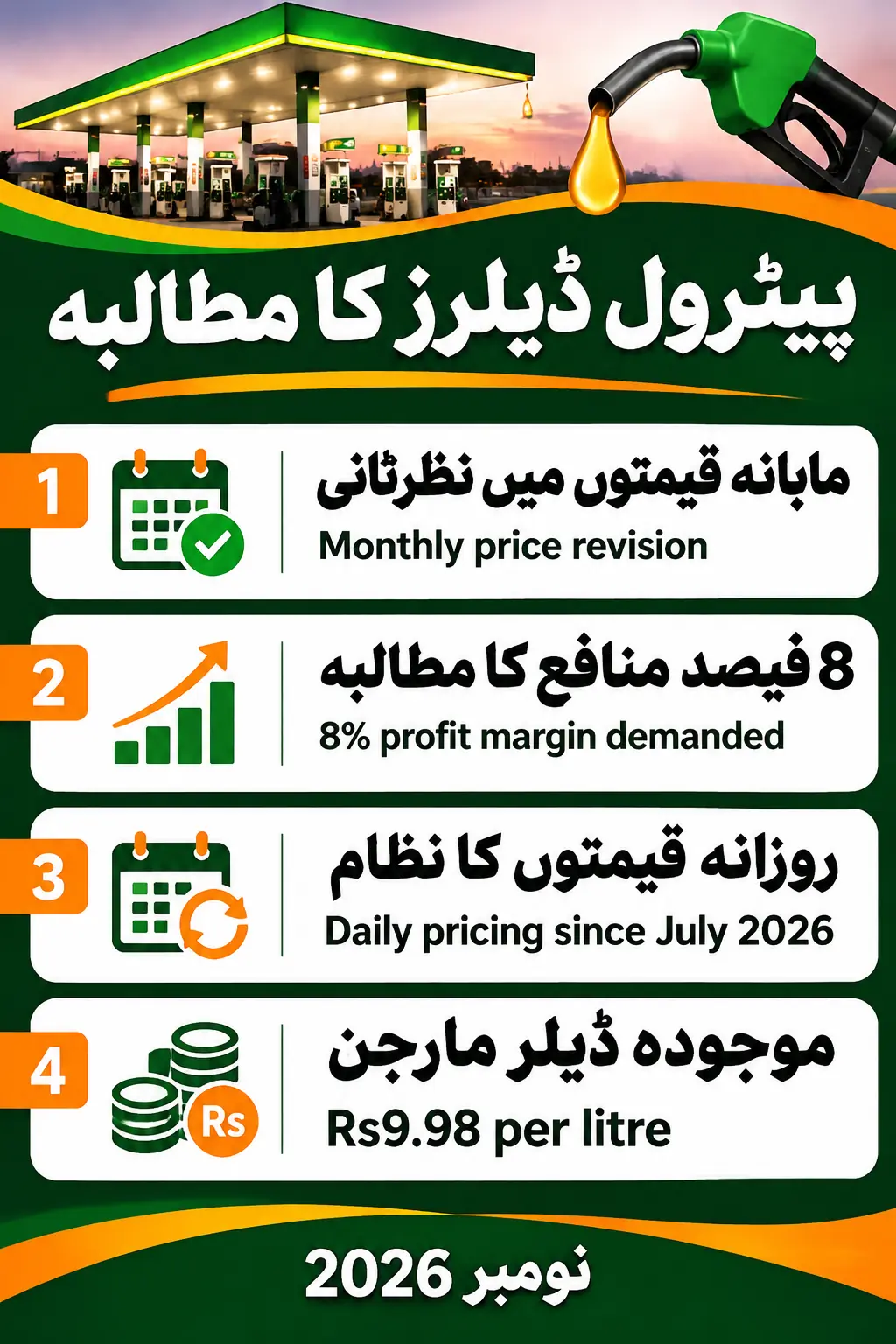
Petrol dealers in Pakistan are asking the government to restore monthly petroleum price revisions instead of changing fuel prices every day. The Pakistan Petroleum Dealers Association (PPDA) has also demanded an increase in dealers’ profit margin to at least 8%, saying frequent price adjustments are creating financial difficulties for petrol pump owners.
PPDA Chairman Malik Khuda Bakhsh has written to Federal Minister for Petroleum Ali Pervaiz Malik with these demands, according to a Business Recorder report published on November 18, 2026.
Separately, the All Pakistan Petrol Pump Owners Association (APPPOA) has approached Prime Minister Shehbaz Sharif with a similar request to replace daily fuel price adjustments with monthly revisions.
However, these are demands from petrol dealers, not approved government changes. Pakistan’s daily petroleum pricing system remains in place as of November 18, 2026.
What Petrol Dealers Are Demanding From the Government
The Pakistan Petroleum Dealers Association wants the government to bring back monthly petroleum price revisions and increase the commission paid to petrol pump owners.
According to Business Recorder, PPDA Chairman Malik Khuda Bakhsh sent a letter to Petroleum Minister Ali Pervaiz Malik on this issue. The association believes daily changes make it difficult for dealers to manage their fuel stocks, working capital and business expenses.
PPDA has made two main demands:
| PPDA demand | Details |
|---|---|
| Petroleum price revisions | Restore monthly adjustments instead of daily revisions |
| Dealers’ profit margin | Increase the margin to at least 8% |
| Association chairman | Malik Khuda Bakhsh |
| Letter recipient | Federal Minister Ali Pervaiz Malik |
| Report date | November 18, 2026 |
The proposed 8% margin is particularly important because dealers currently receive a fixed commission of Rs9.98 per litre. The association wants a percentage-based margin instead.
Neither demand has received a new government approval as of November 18.
APPPOA Also Requests Monthly Fuel Price Revisions
The PPDA is not the only industry association raising concerns about daily petroleum pricing.
The All Pakistan Petrol Pump Owners Association (APPPOA) has separately approached Prime Minister Shehbaz Sharif. Its request is also focused on replacing daily fuel price adjustments with monthly revisions.
Profit by Pakistan Today published a report about this request on November 16, 2026, identifying Nouman Ali Butt as the association’s vice chairman.
APPPOA says frequent price changes create difficulties for petrol pump owners, particularly smaller businesses that have limited financial resources.
How the two associations’ demands differ
Both associations want monthly petroleum price revisions, but their reported communications were addressed to different government officials.
| Detail | PPDA | APPPOA |
|---|---|---|
| Representative | Malik Khuda Bakhsh | Nouman Ali Butt |
| Position | Chairman | Vice Chairman |
| Recipient | Petroleum Minister Ali Pervaiz Malik | PM Shehbaz Sharif |
| Main demand | Monthly revisions | Monthly revisions |
| Additional 8% margin demand | Yes | Not established in the reviewed reporting |
| News report | November 18, 2026 | November 16, 2026 |
The two requests should be understood separately. PPDA has specifically raised the 8% dealer-margin demand, while the APPPOA report focuses on the difficulties caused by daily price adjustments.
Why Petrol Dealers Say Daily Price Changes Are Hurting Their Businesses
Petrol dealers argue that frequent changes in fuel prices create financial uncertainty because they have to manage existing inventory while preparing for their next supplies.
One concern raised by APPPOA is the possibility of inventory losses when petroleum prices decrease.
For example, a petrol pump may purchase fuel at a higher notified price. If the government subsequently reduces the retail price, the dealer may have to sell the remaining stock at the lower rate.
According to the association, this situation puts pressure on dealers who have already paid more for their existing inventory.
Working-capital problems and bank loans
PPDA has also raised concerns about working capital.
Business Recorder reported that PPDA Chairman Malik Khuda Bakhsh said some dealers were taking bank loans to arrange bookings for their next petroleum supplies.
The association believes monthly revisions would provide more predictable conditions for managing inventory, purchasing fuel and meeting operating expenses.
APPPOA has separately highlighted the difficulties faced by small and medium-sized petrol pump owners.
These statements represent the associations’ concerns. Independently verified nationwide figures for dealer inventory losses or bank borrowing have not been established.
How Pakistan’s Daily Petroleum Pricing System Works
Pakistan did not move directly from fortnightly to daily petroleum price revisions. The pricing arrangement changed in stages during 2026.
According to the State Bank of Pakistan’s Annual Report 2025-26, Box 3.5, the country first moved from fortnightly reviews to weekly adjustments before adopting daily pricing.
Petroleum pricing timeline in Pakistan
| Period | Pricing arrangement |
|---|---|
| Before March 2026 | Fortnightly revisions |
| March 2026 | Weekly revisions introduced |
| July 17, 2026 | Daily pricing adopted |
| July 21, 2026 | First single-day notification applied |
The SBP report also explains how the daily pricing formula works.
It uses seven-working-day averages of international Platts Arab Gulf petroleum product prices and the PKR/USD exchange rate. Other import costs, regulated margins, freight and government levies are also considered.
This means Pakistan’s domestic fuel prices do not simply follow the latest international oil quotation every day. OGRA determines and publishes the resulting prices under the revised pricing arrangement.
The current system is the main reason petrol dealers are asking the government to return to monthly adjustments.
Current Petrol Dealer Commission vs Proposed 8% Profit Margin
One of the most important parts of the dealers’ demand is the difference between the existing fixed commission and the proposed percentage-based margin.
At present, OGRA’s November 17, 2026 pricing build-up shows a dealer margin of Rs9.98 per litre.
How the dealer commission increased to Rs9.98
The Economic Coordination Committee (ECC) approved an increase in the existing dealer margin on August 14, 2026.
The commission increased from Rs8.64 to Rs9.98 per litre, representing an increase of Rs1.34.
Dawn reported that petroleum dealers called off their planned strike following the government’s decision.
| Detail | Amount |
|---|---|
| Previous dealer commission | Rs8.64/litre |
| Approved increase | Rs1.34/litre |
| Current dealer commission | Rs9.98/litre |
| ECC decision | August 14, 2026 |
This was an increase in the fixed rupee commission. It was not approval of PPDA’s proposed 8% margin.
How much would an 8% dealer margin mean?
Using the retail fuel prices effective November 18, 2026, an 8% margin would produce the following hypothetical amounts:
| Fuel | Current retail price | Existing fixed margin | Hypothetical 8% margin |
|---|---|---|---|
| Petrol | Rs325 | Rs9.98 | Rs26.00 |
| Diesel | Rs358 | Rs9.98 | Rs28.64 |
The calculations are straightforward:
- Petrol: Rs325 × 8% = Rs26.
- Diesel: Rs358 × 8% = Rs28.64.
These figures are calculations based on current retail prices, not approved commissions.
The proposed 8% margin would therefore be considerably higher than the existing fixed Rs9.98 commission. However, dealers cannot claim these amounts as an officially approved payment unless the government changes the existing arrangement.
Latest Petrol and Diesel Prices in Pakistan on November 18, 2026
The latest petroleum prices became effective on November 18, 2026.
According to the latest OGRA notification, petrol became cheaper by Rs3 per litre, while the price of high-speed diesel remained unchanged.
| Petroleum product | Price per litre | Change |
|---|---|---|
| Petrol | Rs325 | Down Rs3 |
| High-speed diesel | Rs358 | No change |
The petrol reduction was reported as the eleventh consecutive cut.
For the complete rate breakdown, readers can also check our Petrol Price in Pakistan 18 November 2026 update.
Readers interested in the previous notification can visit Petrol Price in Pakistan 17 November 2026.
These current prices are also the basis for calculating the hypothetical 8% dealer margin explained above.
Petroleum Taxes and Levies in the Latest OGRA Build-Up
OGRA’s detailed petroleum price build-up dated November 17, 2026, provides information about the government components included in petrol and diesel prices.
The following figures cover customs duty, petroleum levy, climate support levy and sales tax.
| Component | Petrol | Diesel |
|---|---|---|
| Customs duty | Rs25.94 | Rs15.68 |
| Direct petroleum levy | Rs63.64 | Rs80.00 |
| Climate support levy | Rs5.00 | Rs5.00 |
| Sales tax | Rs0.00 | Rs0.00 |
| Total government component | Rs94.58 | Rs100.68 |
There is an important detail concerning the petrol levy.
The total petroleum levy is Rs80 per litre, including a Rs16.36 refinery levy differential. The direct amount shown in the retail build-up is Rs63.64 because the remaining Rs16.36 is accounted for through refineries.
Therefore, the refinery differential must not be added again when calculating the petrol government’s direct component.
These detailed figures are taken from the November 17 OGRA build-up, rather than simplified tax totals reported elsewhere.
Refinery Earnings Figures Cited by PPDA Need Careful Verification
PPDA also cited higher earnings at major refineries in its letter, as reported by Business Recorder. However, those figures could not be independently verified against the refineries’ audited FY2026 accounts, so this article does not repeat them as verified profits.
The published FY2026 accounts available for several listed refineries show different profit-after-tax figures. This makes it important to distinguish the association’s reported financial argument from independently established company earnings.
Has the Government Approved Monthly Fuel Price Revisions?
No new government approval of monthly petroleum price revisions or an 8% dealer margin had been established as of November 18, 2026.
The November requests from PPDA and APPPOA remain proposals.
There is also relevant historical context. Dawn reported on August 14, 2026, that the government had rejected an earlier request from dealers to replace daily pricing with monthly revisions.
Instead, the ECC approved a fixed Rs1.34 increase in the existing dealer commission, taking it from Rs8.64 to Rs9.98 per litre.
This distinction is important because the August decision did not approve monthly revisions or the proposed 8% margin.
As of November 18, OGRA’s pricing build-up continues to show the fixed Rs9.98 dealer commission.
Therefore, petrol pump owners and customers should not assume that the latest demands have already changed Pakistan’s petroleum pricing policy.
What Could Monthly Fuel Price Revisions Mean for Pakistani Motorists?
A return to monthly pricing could have advantages and disadvantages for ordinary fuel consumers.
For petrol pump owners, less frequent revisions could make it easier to manage fuel inventory, plan purchases and maintain working capital.
However, motorists may also experience a different pricing pattern.
If international petroleum prices fall shortly after a monthly revision, consumers might have to wait until the next adjustment to receive the full benefit of lower prices.
Similarly, when international prices increase, the impact on domestic prices could be delayed until the next revision.
The actual impact would depend on the pricing formula and any future government policy changes.
For now, motorists should continue following official OGRA price notifications rather than treating the dealers’ proposal as an implemented policy.
Frequently Asked Questions
1. Why are petrol dealers demanding monthly fuel price revisions in Pakistan?
Petrol dealers say daily price adjustments make it difficult to manage existing fuel stocks and working capital. PPDA has raised concerns about operating expenses and bank borrowing, while APPPOA says falling prices can create inventory losses, particularly for smaller petrol pump owners.
2. What is PPDA demanding from the government?
The Pakistan Petroleum Dealers Association wants the government to restore monthly petroleum price revisions and increase the dealers’ profit margin to at least 8%. PPDA Chairman Malik Khuda Bakhsh communicated these demands to Petroleum Minister Ali Pervaiz Malik, according to Business Recorder.
3. What did APPPOA ask Prime Minister Shehbaz Sharif?
APPPOA Vice Chairman Nouman Ali Butt approached Prime Minister Shehbaz Sharif with a request to replace daily fuel price adjustments with monthly revisions. The association says frequent price changes create inventory and working-capital difficulties for petrol pump owners.
4. Who is Malik Khuda Bakhsh?
Malik Khuda Bakhsh is the chairman of the Pakistan Petroleum Dealers Association. He is the representative identified in Business Recorder’s November 18 report about the association’s request for monthly petroleum price revisions and an increase in dealers’ profit margin to at least 8%.
5. Who is Nouman Ali Butt?
Nouman Ali Butt is identified as the vice chairman of the All Pakistan Petrol Pump Owners Association. He approached Prime Minister Shehbaz Sharif regarding monthly petroleum price revisions, according to Profit’s report published on November 16, 2026.
6. What is the current petrol dealer commission in Pakistan?
The current fixed petrol dealer commission is Rs9.98 per litre according to OGRA’s November 17 pricing build-up. It increased by Rs1.34 from the previous Rs8.64 following an ECC decision on August 14, 2026.
7. How much would an 8% dealer margin be on petrol and diesel?
Using November 18 retail prices, an 8% margin would equal Rs26 per litre on petrol priced at Rs325 and Rs28.64 on diesel priced at Rs358. These are hypothetical calculations, not government-approved dealer commissions.
8. When did Pakistan introduce daily petroleum price revisions?
Pakistan adopted daily petroleum pricing on July 17, 2026, and the first single-day notification applied on July 21. Before daily pricing, the country had moved from fortnightly to weekly revisions in March 2026.
9. Has the government approved monthly fuel price revisions?
No new approval had been established as of November 18, 2026. The latest requests from PPDA and APPPOA remain demands. Dawn also reported that the government had rejected an earlier monthly-pricing request in August 2026.
10. What are the latest petrol and diesel prices in Pakistan?
Effective November 18, 2026, petrol costs Rs325 per litre and high-speed diesel costs Rs358 per litre. Petrol was reduced by Rs3, while the diesel price remained unchanged under the latest notification.
Conclusion
Petrol dealers in Pakistan are pushing for monthly petroleum price revisions because they believe frequent daily adjustments create inventory and working-capital difficulties.
PPDA has also demanded an increase in dealers’ profit margin to at least 8%, while APPPOA has separately approached the prime minister with its monthly-pricing request.
However, the existing system remains unchanged. OGRA’s November 17 build-up shows a fixed dealer commission of Rs9.98 per litre, and no new approval of monthly revisions or an 8% margin had been established by November 18, 2026.
For motorists, the important point is to distinguish between an association’s demand and an official government decision. Any future change should be confirmed through an official government or OGRA notification.
Disclaimer: pakistanschemes.pk is an independent and unofficial informational website. It is not affiliated with the Government of Pakistan, OGRA or any petrol dealers’ association. This article provides information based on reported industry demands and available official pricing records. Readers should check official notifications for the latest petroleum prices and policy decisions.


2 thoughts on “Petrol Dealers Demand Monthly Fuel Price Revision and 8% Profit Margin in Pakistan — November 2026”