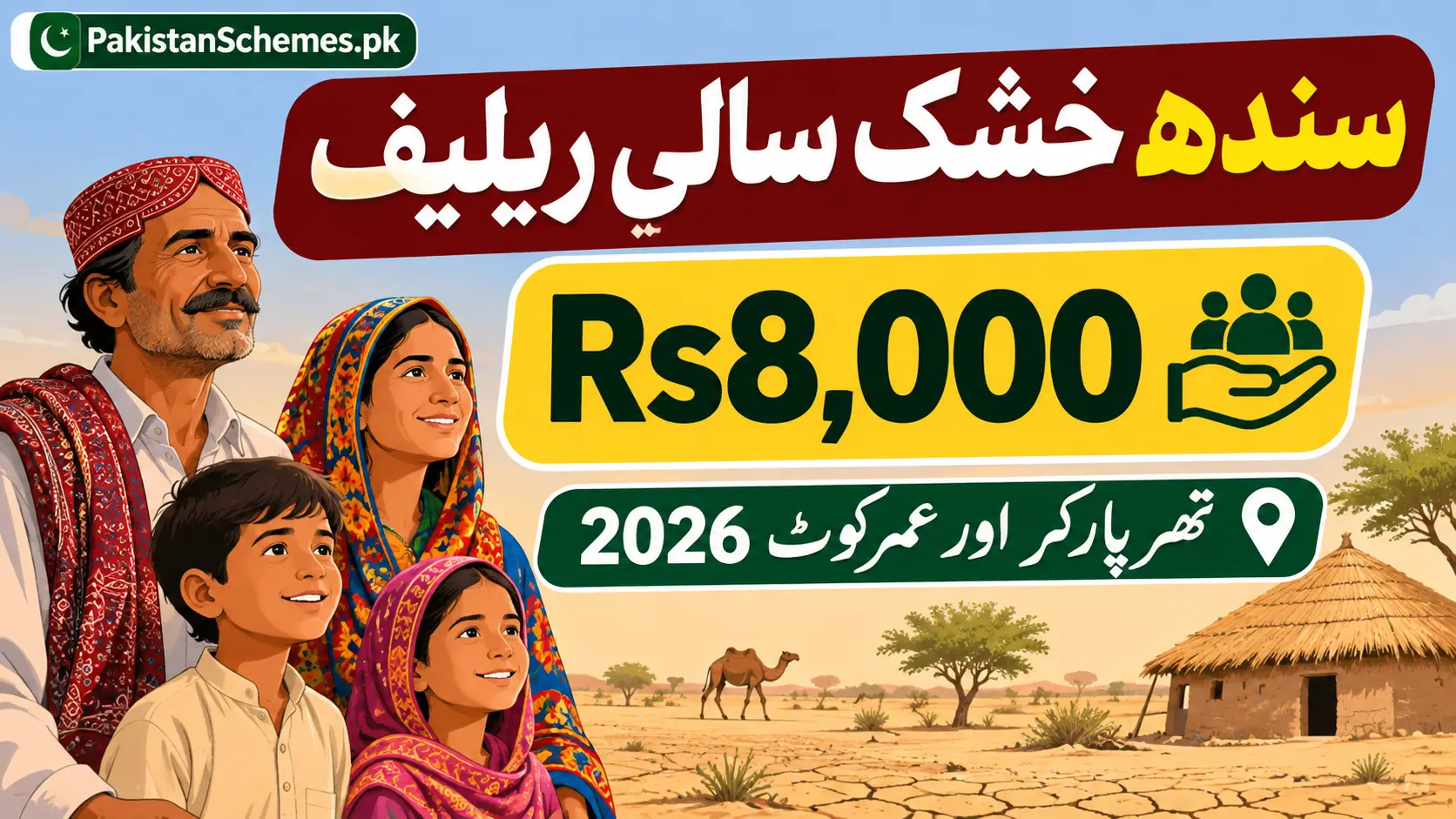
The Sindh government has announced the Sindh drought relief 2026 package for families affected by dry conditions in Tharparkar and Umerkot, with Rs8,000 in total support for each eligible family, paid through the BISP payment mechanism in three instalments.
If you live in Tharparkar or Umerkot, this article explains what the package is, who is eligible, when the payments are scheduled, and how to check your status through official BISP channels.
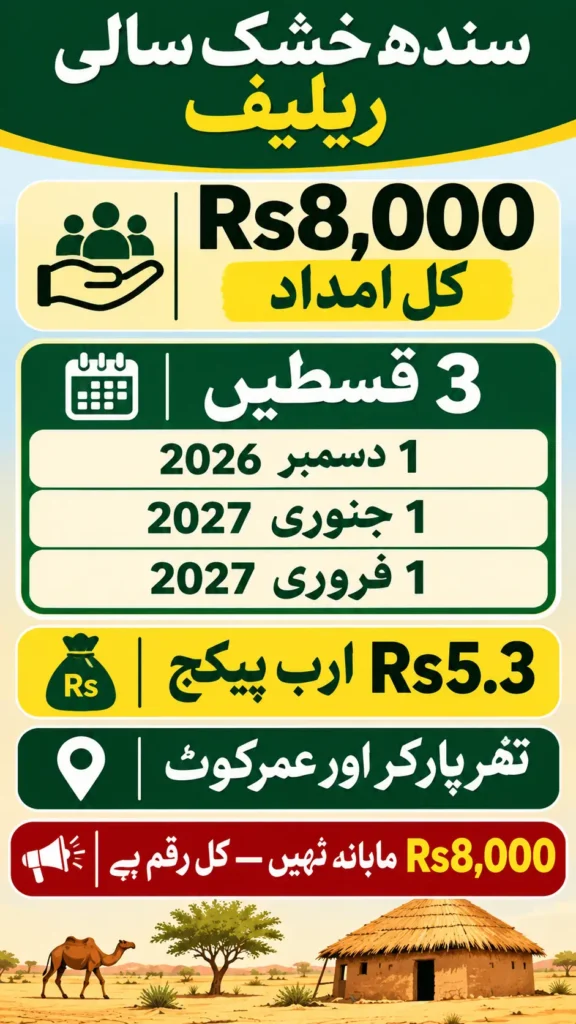
The first and most important point to understand is that the amount is Rs8,000 in total per eligible family, not Rs8,000 every month. Some online posts have repeated the figure as a monthly payment. That reading is incorrect. The relief is split across three instalments, and the total remains Rs8,000.
Sindh Drought Relief Package at a Glance
| Feature | Details |
|---|---|
| Package | Sindh drought relief package 2026 |
| Total amount | Rs5.3 billion |
| Relief amount per family | Rs8,000 in total |
| Number of instalments | Three |
| Payment dates | 1 Dec 2026, 1 Jan 2027, and 1 Feb 2027 |
| Districts covered | Tharparkar and Umerkot |
| Coverage | Tharparkar as a whole, excluding nine canal-irrigated dehs in Kaloi; 25 desert dehs in Umerkot |
| Beneficiaries | About 220,000 families, as reported |
| Eligibility check | BISP data using a PMT score of 0–40 |
| Payment channel | BISP payment mechanism |
| Announcement date | 20 Nov 2026 |
| Announced by | Sindh CM Murad Ali Shah |
| DAP fertiliser subsidy | Rs4,000 per acre for wheat growers, up to 25 acres |
| Review meeting | 22 Nov 2026, with directions for immediate implementation |
This table is useful for anyone who wants a quick summary, but the rest of the article matters too. The eligibility rules, payment process, and common misunderstandings need careful reading, because a single wrong assumption can create unnecessary disappointment or confusion.
What Is the Sindh Drought Relief Package?
The Sindh drought relief package is a response to drought conditions in Tharparkar and Umerkot. These are desert and desert-edge districts where rainfall is low, irregular, and often insufficient for farming and livestock. When rain fails, crops suffer, fodder becomes scarce, water becomes harder to find, and household incomes fall.
The package was announced on 20 November 2026 by Sindh Chief Minister Murad Ali Shah at the launch of the Sindh Wheat Growers Support Programme.
The drought relief scheme is linked to the wider package announced at the event. The scheme includes a separate agricultural support component for wheat growers, with a DAP fertiliser subsidy of Rs4,000 per acre for wheat growers up to 25 acres. This fertiliser support is separate from the Rs8,000 cash relief for affected families.
On 22 November 2026, the Chief Minister held a review meeting on the drought relief arrangements and directed that implementation begin immediately. This suggests the government intends to move from announcement to delivery without long delay, although families should still rely on official announcements for their individual payment status.
Why the Relief Was Announced
Drought in Tharparkar and Umerkot is not only about low rainfall in one season. It affects water availability, crop output, livestock health, and the daily cost of living. Families in desert areas often depend on rain-fed farming and animal rearing, so a weak rainy season can reduce income for months.
The relief package is designed to provide short-term support to families identified through BISP data. It is not a permanent income programme and does not replace regular social protection payments. Its purpose is to help affected households manage essential needs during the drought period.
Rs5.3 Billion Package: What It Means
The Rs5.3 billion figure is the total size of the package announced by the Sindh government. It should not be read as the cash amount that will be paid to each family, and it should not be used to calculate the per-family amount by simple division.
The package includes drought relief for families and support for wheat growers. The exact division of funds between different components has not been published in a way that allows a precise breakdown from the sources available for this article.
What is clear is the family-level figure: Rs8,000 in total per eligible family, paid in three instalments.
Rs8,000 Relief: Total Amount, Not Monthly
This is the most important correction in the entire article.
The Correct Fact
Each eligible family will receive Rs8,000 in total, paid in three instalments.
It is not:
- Rs8,000 every month
- Rs8,000 per month for three months
- Rs24,000 in total
Some aggregator websites and social media posts have written the figure as “Rs8,000 a month”. That is incorrect.
Why the Confusion Happened
The confusion is understandable because the payment is spread over three months. When people see a payment linked to December, January, and February, they may assume the same amount will be paid each month.
That assumption is wrong. The government has announced Rs8,000 as the total relief amount, and that total is divided into three instalments.
What We Do Not Know Yet
The sources do not state the amount of each individual instalment. For example, they do not confirm whether the three instalments will be equal.
No per-instalment amount has been invented in this article. If an official announcement later confirms the amount of each instalment, that information should be checked through official sources before it is treated as final.
Payment Dates and Instalment Schedule
The drought relief will be paid in three instalments on the following dates:
| Instalment | Payment Date | Amount |
|---|---|---|
| 1st instalment | 1 December 2026 | Part of Rs8,000 total |
| 2nd instalment | 1 January 2027 | Part of Rs8,000 total |
| 3rd instalment | 1 February 2027 | Part of Rs8,000 total |
| Total | — | Rs8,000 |
The schedule is straightforward, but families should remember two points:
- The dates are the scheduled payment dates announced by the government.
- Individual payments may depend on the family’s eligibility and the BISP payment process.
If a family does not receive a payment on the expected date, it should check its status through the official BISP channels listed later in this article, rather than relying on social media claims.
Who Is Eligible for Sindh Drought Relief?
Eligibility is based on BISP data and the Poverty Means Test (PMT) score.
PMT Score Limit Raised from 32 to 40
The government has raised the PMT score limit for this relief from 32 to 40. This is an important change because it widens the group of families that can be considered.
Previously, the standard BISP eligibility limit was PMT 0–32. For the drought relief, families with a PMT score of 0–40 are considered.
Eligibility Summary
| Eligibility Condition | Details |
|---|---|
| District | Tharparkar or Umerkot |
| Area | Drought-affected dehs as notified |
| PMT score | 0–40 |
| Data source | BISP data |
| Payment channel | BISP payment mechanism |
| Separate application | No separate application portal has been announced |
Why the PMT Limit Matters
The PMT score is a measure of household poverty based on BISP survey data. A higher PMT score generally indicates a relatively better-off household, while a lower score indicates greater poverty.
By raising the limit from 32 to 40, the government has included more families in the drought relief. This reflects the fact that drought affects a wider group of households, not only the poorest families.
How Many Families Are Covered?
Reports state that about 220,000 families in Tharparkar and Umerkot are expected to benefit from the relief.
This figure should be treated as an approximate and reported figure. It is not an exact final list of recipients.
The BISP database figures reviewed by the Chief Minister are:
| District | PMT 0–32 | PMT 0–40 |
|---|---|---|
| Tharparkar | 129,092 | 192,931 |
| Umerkot | 61,799 | 80,735 |
| Total | 190,891 | 273,666 |
These are BISP database populations, not confirmed recipient counts. They show the number of households in the BISP database within each PMT range. They do not mean that 273,666 families will receive the relief.
The figure of about 220,000 families is the reported estimate of the families expected to benefit. The final number will depend on the official identification process.
Which Areas Are Covered?
The relief covers drought-affected areas in Tharparkar and Umerkot, as notified by the government.
Tharparkar
Tharparkar is covered as a whole district, except for nine canal-irrigated dehs in Kaloi taluka.
This exclusion is important. Canal-irrigated dehs have access to canal water for farming, so they are not treated in the same way as rain-fed desert dehs.
Umerkot
In Umerkot, 25 desert dehs are covered.
These are the desert dehs identified as drought-affected.
Drought Notification
The Sindh government issued a drought notification on 18 November 2026 for 188 dehs, including 163 dehs in Tharparkar and 25 dehs in Umerkot.
This notification is the formal basis for identifying the drought-affected areas. The table below summarises the figures reported in different sources.
| District | Dehs Notified |
|---|---|
| Tharparkar | 163 |
| Umerkot | 25 |
| Total | 188 |
The 9-Deh Difference: What Readers Should Know
There is a small difference in the reported figures for Tharparkar. Some sources report 163 dehs, while others report 172 dehs, after excluding nine canal-irrigated dehs in Kaloi.
The reason for this difference has not been clearly explained in the sources available for this article. It may reflect different counting methods, different stages of notification, or a reporting error.
This article does not invent an explanation. Readers should rely on the official notification and any later official clarification for the exact deh count.
What is certain is that Tharparkar as a whole is covered, except for nine canal-irrigated dehs in Kaloi, and 25 desert dehs in Umerkot are covered.
How Will the Payment Reach Families?
The drought relief will be paid through the BISP payment mechanism. This means the government will use BISP’s existing system to identify eligible families and deliver payments.
What This Means in Practice
Using BISP’s payment mechanism has several practical implications:
- Families already in the BISP database can be identified without a new registration process.
- Payments can be delivered through the same channels used for BISP payments.
- The government does not need to create a completely new payment system for this relief.
No Separate Application Portal
No separate application portal has been announced for the drought relief. This is an important point because fake websites and social media posts often claim to offer registration for new schemes.
Families should not pay anyone to register for this relief, and they should not share personal details on unofficial websites.
How to Check Your Status
Families can check their BISP status through the official BISP channels listed below. These are the general official BISP channels, not a package-specific portal for the drought relief.
| Channel | Details |
|---|---|
| SMS | Send CNIC to 8171 |
| Portal | 8171.bisp.gov.pk |
| Helpline | 0800-26477 |
| Official BISP website | bisp.gov.pk |
These channels can help families check their BISP eligibility and payment status. They do not guarantee that a family will receive the drought relief, because the final identification depends on the official process.
What to Do If You Do Not Receive a Payment
If you believe you are eligible but have not received a payment on the scheduled date, follow these steps:
- Check your status through SMS to 8171 or the BISP portal.
- Contact the BISP helpline on 0800-26477.
- Visit your nearest BISP office if needed.
- Do not pay any agent or third party for help.
DAP Fertiliser Subsidy and Wheat Support
The drought relief package is not only about cash support for families. It also includes support for wheat growers.
DAP Subsidy Details
| Support | Details |
|---|---|
| Subsidy | Rs4,000 per acre |
| Crop | Wheat |
| Maximum area | 25 acres |
| Purpose | Support wheat growers during the season |
The DAP fertiliser subsidy of Rs4,000 per acre is for wheat growers, up to 25 acres. This is separate from the Rs8,000 cash relief for affected families.
Wheat Grower Support
The wheat support was announced at the launch of the Sindh Wheat Growers Support Programme on 20 November 2026.
The programme includes support for wheat growers, including a wheat delivery bonus for growers who deliver wheat to government procurement centres. The details of this bonus, including the exact amount and conditions, have not been confirmed in the sources available for this article.
The wheat support is important because drought affects not only households but also farming. By supporting wheat growers, the government aims to help maintain wheat production in the affected districts.
What Is NOT Included in the Package?
Understanding what the package does not include is just as important as understanding what it does include.
Common Misunderstandings
| Misunderstanding | Correct Fact |
|---|---|
| Rs8,000 per month | Rs8,000 in total, in three instalments |
| Rs24,000 in total | Rs8,000 in total |
| All BISP beneficiaries automatically qualify | Only families in the notified drought-affected areas with PMT 0–40 are considered |
| A separate application is required | No separate application portal has been announced |
| The relief is the same as Kafaalat | The drought relief is separate from regular Kafaalat payments |
| The Rs5.3 billion is paid to each family | Rs5.3 billion is the total package size, not a per-family amount |
Relief vs Kafaalat
The drought relief is separate from regular Kafaalat payments. It is a one-time relief package for drought-affected families in Tharparkar and Umerkot, paid in three instalments.
Regular Kafaalat payments are a separate programme with their own schedule and rules. The drought relief does not replace Kafaalat, and Kafaalat does not replace the drought relief.
Families should not assume that receiving Kafaalat automatically means they will receive the drought relief, or that receiving the drought relief means they will receive Kafaalat.
No Guarantee for Every BISP Beneficiary
Not every BISP beneficiary will receive the drought relief. The relief is limited to:
- Families in Tharparkar and Umerkot
- Families in the notified drought-affected dehs
- Families with a PMT score of 0–40
A family that meets the BISP criteria but lives outside the notified areas will not be eligible for this relief.
What Families Should Do Now
If you live in Tharparkar or Umerkot, here are the practical steps to take:
- Check your BISP status through SMS to 8171 or the BISP portal.
- Confirm your district and deh are in the notified drought-affected areas.
- Wait for the scheduled payment dates: 1 December 2026, 1 January 2027, and 1 February 2027.
- Do not pay anyone for registration or assistance.
- Use only official channels for information and updates.
If you are not sure about your eligibility, contact the BISP helpline or visit your nearest BISP office.
Frequently Asked Questions
1. What is the Sindh drought relief package 2026?
The Sindh drought relief package 2026 is a Rs5.3 billion package announced by Sindh Chief Minister Murad Ali Shah on 20 November 2026 for families affected by drought in Tharparkar and Umerkot. It provides Rs8,000 in total to each eligible family, paid in three instalments through the BISP payment mechanism.
2. How much will each family receive?
Each eligible family will receive Rs8,000 in total. This is not a monthly amount. The total is paid in three instalments on 1 December 2026, 1 January 2027, and 1 February 2027.
3. Is the Rs8,000 paid every month?
No. The Rs8,000 is the total amount, not a monthly payment. Some online posts have incorrectly described it as “Rs8,000 a month”. The correct fact is Rs8,000 in total, split into three instalments.
4. Who is eligible for the drought relief?
Families in Tharparkar and Umerkot who are in the notified drought-affected areas and have a PMT score of 0–40 in the BISP data are considered for the relief. The PMT limit was raised from 32 to 40 for this package.
5. Is the drought relief the same as Benazir Kafaalat?
No. The drought relief is separate from regular Kafaalat payments. It is a one-time relief package for drought-affected families, paid in three instalments. Kafaalat is a separate programme with its own schedule and rules.
6. How can I check my eligibility?
You can check your BISP status by sending your CNIC number by SMS to 8171, visiting the portal 8171.bisp.gov.pk, or calling the helpline 0800-26477. These are the official BISP channels.
7. Do I need to apply separately for the relief?
No separate application portal has been announced. The relief is based on BISP data. Families should not pay anyone to register and should not share personal details on unofficial websites.
8. When will the payments be made?
The payments are scheduled for 1 December 2026, 1 January 2027, and 1 February 2027. The exact amount of each instalment has not been confirmed in the sources available for this article.
9. How many families will benefit?
Reports state that about 220,000 families in Tharparkar and Umerkot are expected to benefit. This is an approximate and reported figure, not a final confirmed recipient count.
Final Words
The Sindh drought relief package is an important step for families in Tharparkar and Umerkot who are facing the effects of drought. The Rs8,000 in total per eligible family, paid in three instalments, can provide some support during a difficult period.
The most important thing for families to remember is the correct amount: Rs8,000 in total, not per month. They should also remember the payment dates — 1 December 2026, 1 January 2027, and 1 February 2027 — and use only official BISP channels to check their status.
The government has directed immediate implementation, and the review meeting on 22 November 2026 shows that the programme is being taken seriously. Families in the affected districts should stay informed through official announcements and avoid relying on social media claims.
Note: This article is based on information available as of 23 November 2026. Readers should check official announcements for the latest updates, as details may change.