
Pakistan 5G Auction Second Phase
Pakistan has entered an important stage in the development of next-generation mobile technology with the launch of the Pakistan 5G Auction Second Phase. After the successful completion of the first stage, the Pakistan Telecommunication Authority (PTA) is now organizing the second phase to finalize how telecom operators will position their spectrum within the allocated frequency bands. This stage focuses on technical placement rather than purchasing new spectrum blocks.
The positioning of frequency bands is an essential part of spectrum management because it determines how efficiently telecom operators can operate their networks. Proper placement reduces interference between networks and allows companies to deliver faster and more stable internet services. Through this structured process, PTA aims to ensure fair competition while preparing the telecom sector for nationwide 5G deployment.

Key Highlights of the Second Phase
- Conducted by the Pakistan Telecommunication Authority
- Focused on spectrum positioning instead of new purchases
- Telecom companies will compete for preferred frequency placement
- Includes major 5G spectrum bands used globally
- Designed to ensure efficient use of telecom resources
The second phase represents a technical yet critical step toward launching advanced mobile connectivity across Pakistan.
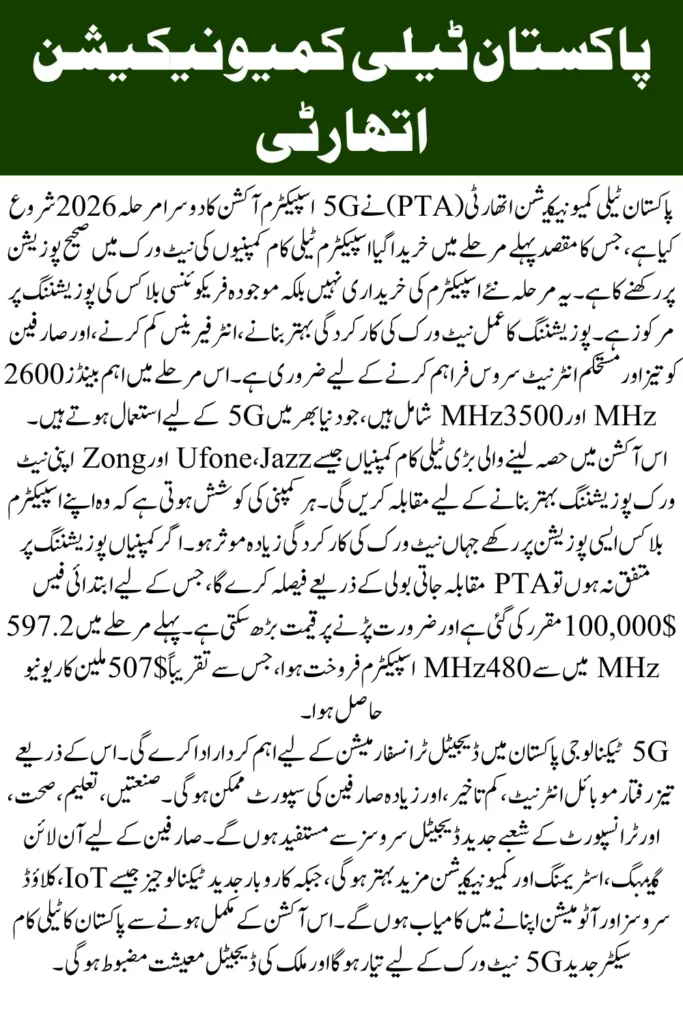
PTA’s Plan for Spectrum Assignment in 2600 MHz and 3500 MHz Bands
The Pakistan Telecommunication Authority has structured the second phase of the auction as an assignment-based process that focuses on two important frequency ranges: 2600 MHz and 3500 MHz. These spectrum bands are widely used in modern telecom networks because they provide a balance between speed and coverage, making them suitable for large-scale 5G deployment.

Under this plan, telecom operators will determine where their allocated spectrum blocks will sit within the overall frequency band. For example, operators may compete for top, middle, or lower positions within the spectrum. Each position can influence network performance and compatibility with existing infrastructure.
Frequency Bands Included in the Auction
| Frequency Band | Importance for 5G Networks |
|---|---|
| 2600 MHz | High-capacity broadband services |
| 3500 MHz | Global standard band for 5G rollout |
Key points about these bands include:

- Support high-speed mobile data services
- Suitable for densely populated urban areas
- Allow efficient handling of heavy internet traffic
- Provide balanced coverage and capacity
These frequencies form the technical foundation for building Pakistan’s future 5G infrastructure.
Telecom Operators Participating in the 5G Spectrum Positioning Auction
Major telecom companies operating in Pakistan are expected to participate in the 5G spectrum positioning auction. These operators previously secured spectrum during the first phase of the auction and are now preparing to determine the most suitable placement of their allocated blocks.
The companies involved include Pak Telecom Mobile Limited, Pakistan Mobile Communications Limited, and Zong. Each of these operators aims to secure positions that allow them to optimize their network performance and expand their digital services in the future.
Major Telecom Operators in the Auction
| Telecom Operator | Spectrum Acquired in Phase One |
|---|---|
| Pak Telecom Mobile Limited (Ufone) | 180 MHz |
| Pakistan Mobile Communications Limited (Jazz) | 190 MHz |
| Zong | 110 MHz |
Important points about participating companies:
- These operators serve millions of mobile users across Pakistan
- Each company plans to invest heavily in next-generation infrastructure
- The positioning auction helps them prepare for future 5G deployment
- Network upgrades will likely begin in major cities first
Their participation reflects strong competition in Pakistan’s telecommunications market.
Initial Positioning Fee and Possible Bidding Rounds
To manage the spectrum positioning process, PTA has established a starting fee for companies that wish to compete for preferred positions within the frequency bands. The initial positioning fee has been set at $100,000. This fee allows operators to participate in the bidding process if they cannot mutually agree on spectrum placement.
If multiple telecom companies compete for the same frequency position, the auction may proceed through several rounds of bidding. In such cases, the price can increase significantly as operators attempt to secure better placement for their networks.
Key Details of the Bidding Process
- Initial positioning fee begins at $100,000
- Additional bidding rounds may increase the cost
- Prices may rise to as much as $1 million in later rounds
- PTA supervises the process to maintain transparency
This system ensures that spectrum placement decisions are made fairly while also generating additional revenue for the government.
Revenue Generated from the First Phase of the 5G Auction
The first phase of Pakistan’s 5G spectrum auction generated significant revenue for the government. During this stage, telecom operators competed to purchase available spectrum blocks that will later be used to deploy 5G services. The strong participation from telecom companies demonstrated the high demand for advanced connectivity infrastructure.
Out of a total 597.2 MHz spectrum available, approximately 480 MHz was successfully sold in the first phase. The auction generated about $507 million in revenue, making it one of the largest telecom-related financial events in the country in recent years.
First Phase Auction Summary
| Auction Category | Details |
|---|---|
| Total Spectrum Offered | 597.2 MHz |
| Spectrum Sold | 480 MHz |
| Total Revenue | Around $507 million |
| Additional Revenue Expected | $1–2 million from positioning auction |
Key observations from the first phase:
- Strong competition among telecom companies
- Large portion of available spectrum successfully allocated
- Significant financial contribution to the national economy
The results confirm strong interest from telecom operators in expanding next-generation networks.
Role of 5G Technology in Pakistan’s Digital Transformation
The introduction of 5G technology is expected to play a central role in Pakistan’s digital transformation. Compared with previous mobile technologies, 5G offers significantly faster speeds, extremely low latency, and the ability to support a much larger number of connected devices.
These capabilities open the door for new innovations in multiple sectors. Industries such as healthcare, education, transportation, agriculture, and finance can benefit from advanced digital services powered by 5G connectivity.
Key Areas Where 5G Can Transform Pakistan
- Smart manufacturing and industrial automation
- Remote healthcare services and diagnostics
- Digital education and virtual classrooms
- Intelligent transportation systems
- Expansion of cloud-based services
By strengthening digital infrastructure, 5G technology can help Pakistan move toward a more connected and technology-driven economy.
Expected Benefits of 5G for Consumers and Businesses
The deployment of 5G networks will bring significant improvements for both individual users and businesses. For consumers, the most noticeable benefit will be extremely fast internet speeds that allow seamless streaming, gaming, and communication. The improved network reliability will also enhance the performance of online platforms and mobile applications.
Businesses will gain access to advanced digital tools that enable automation, data analysis, and real-time connectivity. Industries can use 5G-powered technologies to improve efficiency, reduce operational costs, and develop innovative services that were not possible with earlier network generations.
Major Advantages of 5G Deployment
- Ultra-fast mobile internet speeds
- Reduced latency for real-time applications
- Support for Internet of Things devices
- Improved connectivity for businesses and startups
- Greater reliability for digital services
These benefits will help accelerate innovation and strengthen Pakistan’s digital economy.
FAQs
What is the Pakistan 5G Auction Second Phase?
It is the stage where telecom companies compete to determine the positioning of their previously acquired spectrum within specific frequency bands.
Which frequency bands are included in the second phase?
The auction focuses on the 2600 MHz and 3500 MHz bands used for 5G deployment.
How much revenue was generated in the first phase?
The first phase generated approximately $507 million from the sale of 480 MHz of spectrum.
What is the starting fee for spectrum positioning?
The initial positioning fee set by PTA is $100,000, which may increase through additional bidding rounds.
How will 5G benefit Pakistan’s telecom sector?
5G will improve network speed, enable advanced digital services, and support innovation across multiple industries.





Conclusion
The Pakistan 5G Auction Second Phase represents an important technical step in the rollout of next-generation mobile networks. By determining the final placement of spectrum blocks within key frequency bands, telecom operators can prepare their networks for future 5G services.
With strong participation from major telecom companies and significant revenue generated in the first phase, Pakistan is moving closer to launching advanced connectivity. The expansion of 5G technology will not only improve internet services but also support the country’s long-term digital transformation and economic growth.