The transport fare reduction Pakistan November 2026 announcement has brought some hope for passengers and businesses facing high transportation costs. On Thursday, 19 November 2026, Federal Minister for Planning, Development and Special Initiatives Prof. Ahsan Iqbal chaired an emergency National Price Monitoring Committee (NPMC) meeting and directed federal and provincial governments to reduce passenger and freight transport fares after recent petrol and diesel price reductions.
The minister asked provincial governments to issue revised fare notifications through their concerned departments and ensure transport operators follow the updated schedules. The government also wants lower freight charges so businesses and households can benefit from reduced fuel costs.
However, you should understand one important point: this is a government directive, not an implemented nationwide fare reduction. No revised national fare amounts were announced at Thursday’s meeting. No provincial revised fare notification dated 19 or 20 November was located in the available research.
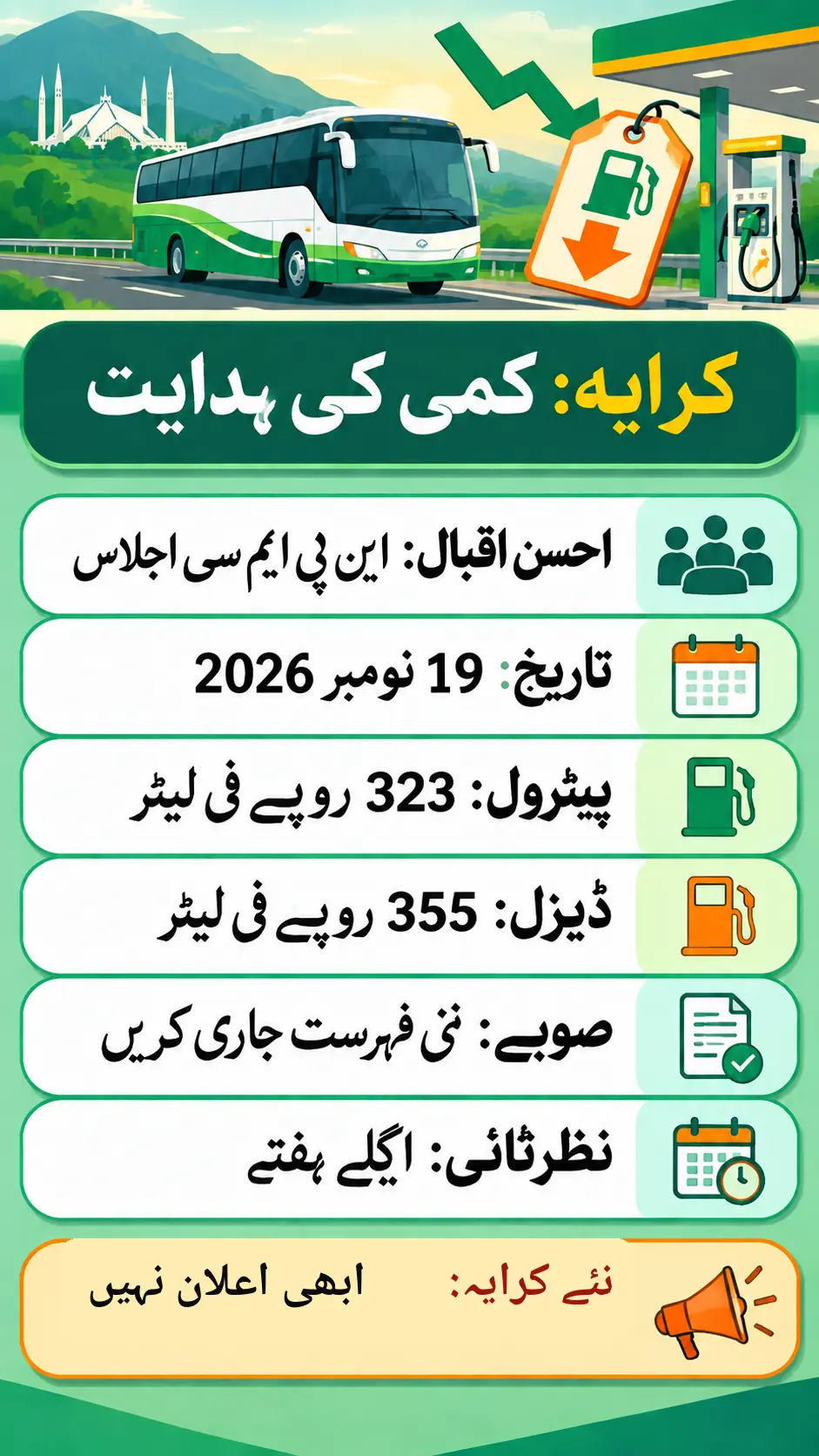
At a Glance
| Detail | Latest information |
|---|---|
| Date of decision | Thursday, 19 November 2026 |
| Meeting | Emergency National Price Monitoring Committee (NPMC) meeting |
| Chair | Prof. Ahsan Iqbal, Federal Minister for Planning, Development and Special Initiatives |
| Directive | Reduce passenger and freight transport fares after the fall in petrol and diesel prices |
| Who must act | Federal and provincial governments, through the departments concerned |
| Next step | Provinces to issue revised fare schedules and monitor compliance |
| Next review | NPMC to meet again within a week |
| Petrol price on 20 November | Rs323 per litre |
| Diesel price on 20 November | Rs355 per litre |
| Revised fares announced? | No — this is a directive, not an implemented fare cut |
Source: PID official press release, 19 November 2026; Arab News; Business Recorder.
What Did Ahsan Iqbal Direct?
At the emergency NPMC meeting, the federal minister reviewed the latest price situation and the relief already reflected in fuel prices. He said that transporters should pass the benefit of lower fuel prices to passengers and businesses. The directive covered both passenger transport and the movement of goods.
The minister noted that fuel costs are a major part of transport fares. When petrol and diesel become cheaper, fares should also come down. The meeting also discussed the effect of reduced freight charges on prices of goods. Freight charges affect the prices consumers pay for goods transported to markets.
The federal government has directed the departments concerned to work with provincial authorities. This coordination is important because transport fares are managed at the provincial and district levels. The federal government can issue instructions, but provincial governments must issue notifications to change the fare structure.
Who Has to Issue the Revised Fares and How?
The directive is addressed to both the federal and provincial governments. However, the practical work of changing fares will happen at the provincial level. Provincial governments must issue revised fare schedules through the departments concerned.
- Provincial departments prepare revised passenger fare lists for local and intercity routes.
- Provincial departments prepare revised freight charges for goods transport.
- The revised lists are issued as notifications and shared with transporters and the public.
- Transport authorities monitor transporters to ensure they charge the revised fares.
- The NPMC reviews the action taken at its meeting within a week.
Until the provinces issue these notifications, the old fare lists remain in force. Passengers should therefore check the fare list displayed at the terminal or in the vehicle before paying.
Have Transport Fares Actually Been Reduced Yet?
No. This is the most important point to understand. The NPMC meeting issued a direction to reduce fares, but it did not announce revised national fares. Arab News reported that no revised fares were announced at Thursday’s meeting, and no provincial revised fare notification dated 19 or 20 November was located in the available research.
The directive is a first step. The actual reduction will only happen when provinces issue revised fare schedules and transporters start charging the new fares. Until then, you may still be charged the old fare.
| Question | Status |
|---|---|
| Has the government directed a fare reduction? | Yes — on 19 November 2026 |
| Have revised fares been announced? | No |
| Has any province issued a revised fare notification? | No notification dated 19 or 20 November was located |
| Is a national percentage cut fixed? | No — no percentage or amount was announced |
| Are transporters bound by the directive? | Only after revised fare lists are notified by the province concerned |
| Is further government action expected? | Yes — the NPMC will meet again within a week to review the action taken by federal and provincial governments |
What Are Today’s Petrol and Diesel Prices?
Fuel prices are the reason behind the directive. According to the petrol price on 20 November 2026, petrol costs Rs323 per litre today. High-speed diesel costs Rs355 per litre.
| Fuel | Price on 20 November 2026 | Change |
|---|---|---|
| Petrol | Rs323 per litre | Up Re1 from Rs322 |
| High-speed diesel | Rs355 per litre | Unchanged |
Both fuels fell by Rs3 per litre on 19 November. Petrol then rose by Re1 on 20 November, while diesel stayed at Rs355. You can read our daily update on the petrol price on 20 November 2026, and the previous price was reported in our petrol price on 19 November 2026 update.
Separately, petroleum dealers have raised the issue of pricing frequency. You can read about the petroleum dealers’ demand for monthly fuel price revisions.
How Much Have Fuel Prices Fallen Since 12 November?
Fuel prices have fallen sharply since 12 November. The table below shows the OGRA-notified retail prices reported in the site’s daily price updates.
| Date | Petrol (Rs/litre) | Diesel (Rs/litre) |
|---|---|---|
| 12 November 2026 | 335 | 364 |
| 14 November 2026 | 330 | 360 |
| 17 November 2026 | 328 | 358 |
| 18 November 2026 | 325 | 358 |
| 19 November 2026 | 322 | 355 |
| 20 November 2026 | 323 | 355 |
Petrol has fallen by Rs12 per litre since 12 November, from Rs335 to Rs323. Diesel has fallen by Rs9 per litre, from Rs364 to Rs355.
PBS Figures Presented to the NPMC
The Pakistan Bureau of Statistics presented different figures to the NPMC. Business Recorder reported that, according to PBS, petrol fell from Rs396.06 to Rs322 over the 20 days to 12 November, while diesel fell from Rs398.80 to Rs355. This is a reduction of about Rs74 for petrol and about Rs43.80 for diesel.
PBS also reported that the Sensitive Price Indicator fell by 0.46% in the week ending 12 November, after rising by 0.29% in the previous week.
Important: the PBS figures use a different price series from the OGRA-notified retail prices in the table above. The PBS series is likely an average, and its starting point of Rs396.06 does not match the OGRA-notified pump price of Rs335 on 12 November. Do not mix the two series. The table above shows the pump prices you actually pay; the PBS figures show the trend in the PBS series presented to the committee.
Why Do Freight Charges Matter?
The directive covers freight charges as well as passenger fares. This matters because freight charges are part of the cost of moving goods to markets. When freight charges fall, the prices of food and other goods can also come down.
Prof. Ahsan Iqbal asked for lower freight charges for this reason. If transporters continue to charge the old freight rates, the benefit of cheaper diesel will not reach consumers. The effect will be visible only if provincial authorities include freight rates in their revised schedules and enforce them.
What Happens Next — NPMC Review Within a Week
The NPMC will meet again within a week to review the action taken by federal and provincial governments. This gives the provinces a short deadline to issue revised fare schedules and report back to the committee.
Separately, committee-level talks between the government and Jamaat-e-Islami on a petrol relief package concluded on 19 November. That package is a separate matter from the fare directive, and its final approval is still pending. You should not confuse the two developments.
What Should You Do as a Passenger?
Until revised fares are notified, follow these steps when you travel:
- Check the fare list displayed at the terminal or inside the vehicle before you pay.
- Ask the conductor for the current fare for your route.
- Keep your ticket or receipt, especially if you pay more than the displayed fare.
- If a transporter charges more than the notified fare, note the vehicle number and route.
- Report the matter to the concerned transport authority in your district or province.
In Rawalpindi, the district administration set up helpline 1071 to report overcharging after the earlier fare reduction on 12 November. This helpline applies to Rawalpindi only. Other districts may have their own complaint systems.
Earlier Fare Reductions in Rawalpindi and Lahore
Some fare reductions were already announced in Punjab before the NPMC directive. On 12 November, the Rawalpindi district administration reduced local transport fares by 12%, intercity fares by 5% and freight charges by 10%. The administration also set up helpline 1071 for complaints.
In Lahore, the Regional Transport Authority issued revised fare lists around 11 November, with reductions of up to Rs100 on some routes and freight reductions of up to 3%. These were local developments, not the NPMC directive of 19 November. They show, however, that provincial authorities have already started passing fuel relief to passengers in some cities.
Local Transport Enforcement and District-Level Action on 19 November
Local authorities also took action on 19 November. In Peshawar, the Commissioner directed transport authorities to enforce existing notified fare lists. In Astore, the Deputy Commissioner directed the concerned departments to revise fares, and the local administration reported it would take action against overcharging.
These are district-level actions, not provincial fare notifications. No fare amounts were announced in either case. They show that enforcement has begun in some districts, but the revised provincial fare lists are still awaited.
Fuel Prices Compared With Earlier Levels
Even after the recent reductions, fuel prices remain much higher than before the current period of high prices. According to Arab News, petrol at Rs323 per litre on 20 November was still 25.1% above its reported pre-war level of Rs258.17 per litre, while diesel at Rs355 was 28.8% above the reported pre-war level of Rs275.70.
The same report noted that petrol reached a peak of Rs458.41 per litre in April, while diesel peaked at Rs520.35 per litre. These figures are reported by Arab News, which described the recent highs as “US-Iran war highs”. The pre-war levels and peak prices are therefore presented with that attribution.
Common Mistakes to Avoid
- Treating the directive as a fare cut: The government has directed provinces to reduce fares. No revised fares have been announced yet.
- Using Rs325 as today’s petrol price: Rs325 was the petrol price on 18 November. The price on 20 November is Rs323 per litre.
- Mixing the PBS and OGRA price series: The PBS figure of Rs396.06 and the OGRA-notified price of Rs335 on 12 November come from different series. Do not combine them in one calculation.
- Expecting a fixed percentage cut: No percentage or amount was announced at the NPMC meeting. The reduction will be decided by each province.
- Assuming the Rawalpindi or Lahore cuts are the new directive: Those were earlier local developments around 11-12 November, not the NPMC directive of 19 November.
- Expecting immediate relief: Fares will change only after provinces issue revised lists and transporters follow them.
- Ignoring freight charges: Freight rates affect the prices of goods. The directive covers both passenger fares and freight.
- Paying more than the displayed fare: Always check the fare list and keep your ticket.
Frequently Asked Questions
1. Have transport fares been reduced?
No. The government has directed federal and provincial governments to reduce passenger and freight transport fares, but no revised fares have been announced yet. The reduction will happen only after provinces issue revised fare schedules.
2. When will the new fares apply?
The new fares will apply after provincial governments issue revised fare notifications. The NPMC will meet again within a week to review the action taken. No exact date has been announced for the revised lists.
3. Who issues the revised fares?
Provincial governments issue revised fare schedules through the departments concerned. The federal government has directed them to do so, but the notifications must come from the provinces.
4. Will freight charges also be reduced?
The directive covers freight charges as well as passenger fares. The minister said lower freight charges would help reduce the prices consumers pay for goods transported to markets.
5. What are today’s petrol and diesel prices?
Petrol costs Rs323 per litre and high-speed diesel costs Rs355 per litre on 20 November 2026. Petrol rose by Re1 from Rs322 on 19 November, while diesel remained unchanged.
6. How much has petrol fallen since 12 November?
Petrol has fallen from Rs335 per litre on 12 November to Rs323 per litre on 20 November, a reduction of Rs12 per litre. Diesel has fallen from Rs364 to Rs355 per litre over the same period.
7. What should I do if a transporter still charges the old fare?
Check the fare list displayed at the terminal or in the vehicle. Keep your ticket or receipt, note the vehicle number and route, and report the matter to the concerned transport authority. In Rawalpindi, you can use helpline 1071.
8. When is the next NPMC meeting?
The NPMC will meet again within a week of the 19 November meeting to review the action taken by federal and provincial governments. No exact date has been announced.
Final Thoughts
The transport fare reduction Pakistan November 2026 directive is an important step, but it is only a first step. The government has recognised that passengers and businesses should benefit from lower petrol and diesel prices. The real test will be whether provinces issue revised fare lists quickly and whether transporters follow them.
You should check this page again after the NPMC meets within a week. The revised fare lists, when issued, will tell you the exact fares for your route. Until then, check the fare list at the terminal, keep your ticket and report overcharging to the transport authority concerned.
PakistanSchemes.pk is an unofficial information website. It is not affiliated with the Government of Pakistan, the Ministry of Planning, Development and Special Initiatives or the National Price Monitoring Committee. Always verify the latest fare lists with the transport department concerned before you travel. Sources: PID Press Release No. 252, 19 November 2026; Arab News; Business Recorder.