
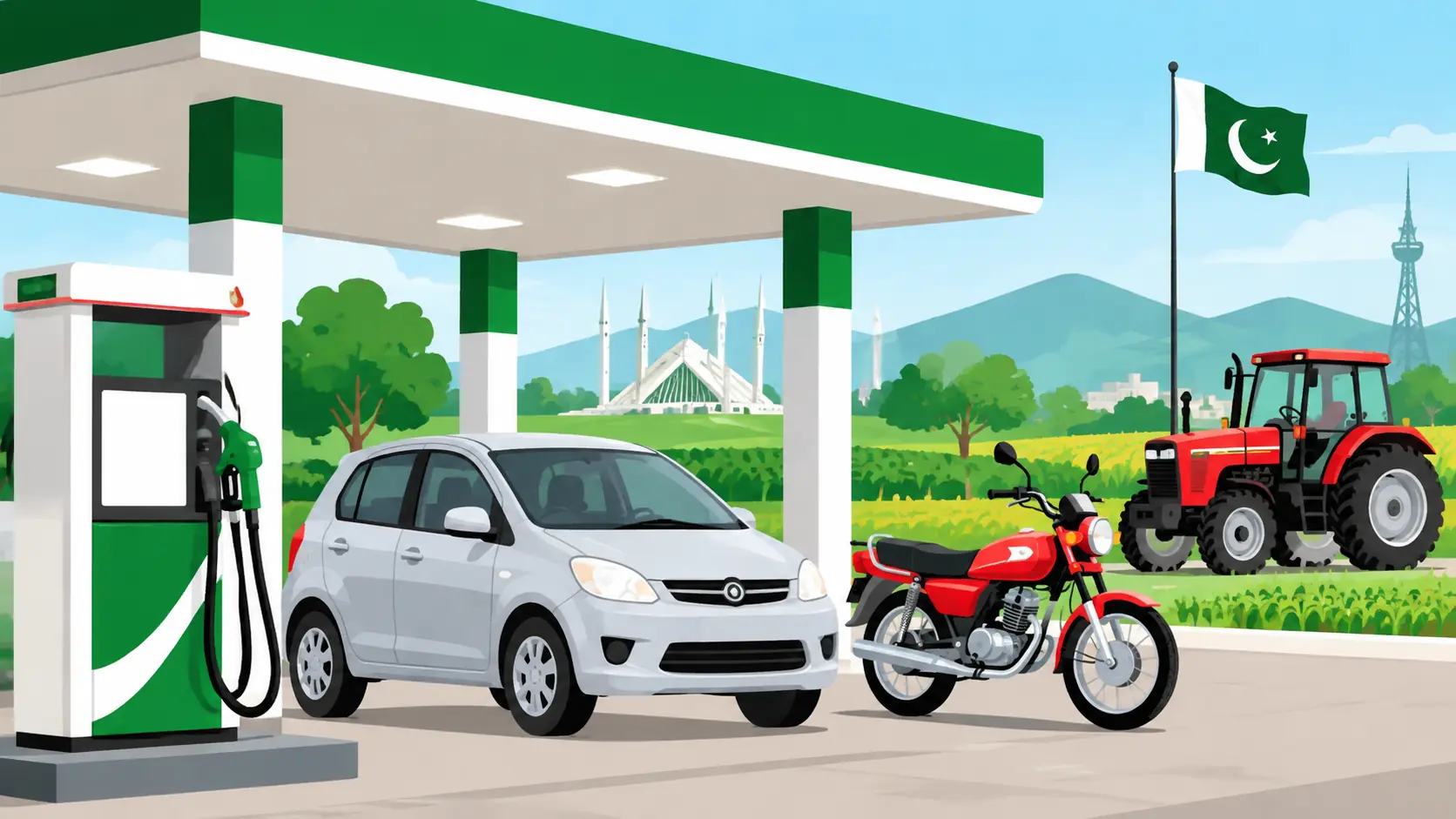
Government and Jamaat-e-Islami (JI) negotiations over the petrol relief package November 2026 concluded at committee level on Thursday, 19 November. JI Naib Emir Liaquat Baloch announced the development after meeting a government delegation led by Deputy Prime Minister and Foreign Minister Ishaq Dar in Islamabad.
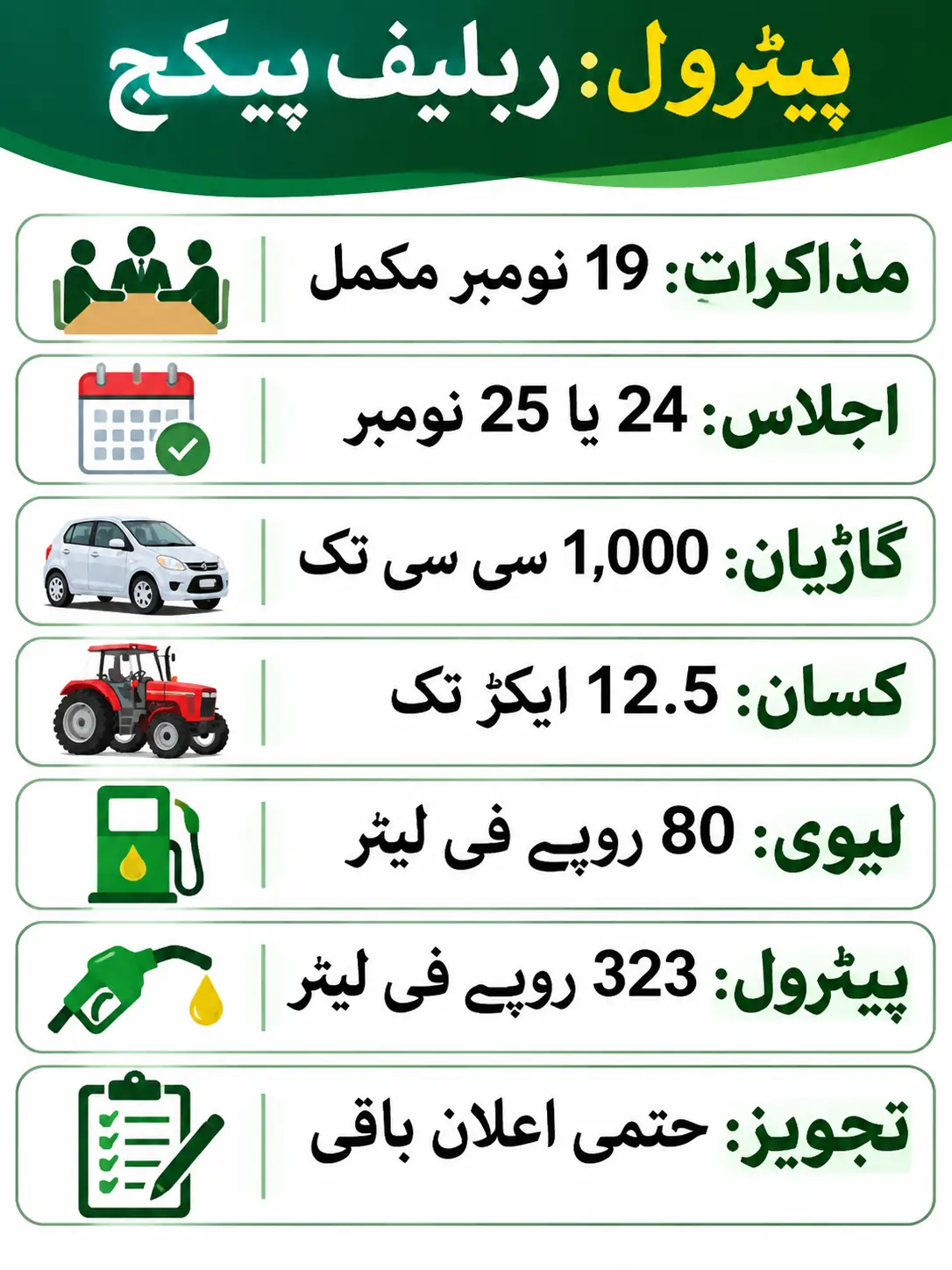
The proposed package could extend fuel relief to vehicles with engines up to 1,000cc and provide diesel assistance to small farmers cultivating up to 12.5 acres. However, these are proposals, not officially approved benefits. The government and JI are now expected to take the proposals to a final leadership-level meeting.
According to Baloch, Prime Minister Shehbaz Sharif and JI Emir Hafiz Naeemur Rehman may meet on 24 or 25 November. The government has confirmed that a final meeting will take place in the Prime Minister’s presence, but its official statement does not confirm either date.
At a Glance
| Detail | Latest information |
| Latest development | Committee-level talks concluded on 19 November |
| Government delegation | Led by Ishaq Dar |
| JI delegation | Led by Liaquat Baloch |
| Expected final meeting | 24 or 25 November, according to JI |
| Proposed vehicle eligibility | Up to 1,000cc |
| Proposed farmer eligibility | Up to 12.5 acres |
| Existing scheme | Motorcycles, three-wheelers and cars up to 800cc |
| Officially notified petrol levy | Rs80 per litre |
| Petrol price on 20 November | Rs323 per litre |
| Final package approval | Pending |
What Happened on 19 November?
Government and Jamaat-e-Islami representatives held another round of discussions in Islamabad on Thursday, 19 November 2026.
The government delegation was led by Deputy Prime Minister and Foreign Minister Ishaq Dar, while JI Naib Emir Liaquat Baloch headed the party’s delegation.
According to the official government statement, both sides discussed petroleum prices and possible expansion of the existing fuel relief programme. The government also reiterated its intention to reduce the financial burden on ordinary consumers.
After the meeting, Liaquat Baloch announced that negotiations at committee level had concluded and draft proposals had been finalised.
This is an important development, but it does not mean that the complete package has received final government approval.
There are separate steps involved:
- Negotiating committees discuss and prepare proposals.
- Political leadership reviews the proposals.
- The government approves the final policy.
- Relevant departments issue implementation instructions.
The 19 November development relates to the committee-level negotiations. The final eligibility rules, subsidy amounts and implementation arrangements are still pending.
You can read the Dawn report on the completion of government-JI petroleum relief talks.
When Will the Final Petrol Relief Package Be Announced?
The next important development is expected after a meeting between Prime Minister Shehbaz Sharif and JI Emir Hafiz Naeemur Rehman.
Liaquat Baloch has identified Tuesday, 24 November, or Wednesday, 25 November, as the expected meeting dates.
The purpose of this meeting is to discuss the proposals prepared during negotiations and move towards a final decision on petroleum relief.
What Did the Government Officially Confirm?
The Pakistan Information Department’s statement dated 19 November confirmed the meeting between Ishaq Dar and the JI delegation.
It also said that a final meeting would take place in the Prime Minister’s presence.
However, the official statement did not specify 24 or 25 November.
These dates come from the JI side, particularly Liaquat Baloch’s statement. Therefore, you should treat them as expected dates rather than a confirmed government appointment.
The Express Tribune report on the expected PM-JI meeting also covers this development.
What Is Proposed Under the Petrol Relief Package November 2026?
The proposed expansion could benefit two important groups: owners of smaller vehicles and small farmers.
However, the government has not issued a final notification confirming these categories.
Vehicles Up to 1,000cc May Become Eligible
The existing PM fuel relief programme covers eligible cars with engines up to 800cc, along with motorcycles and three-wheelers.
During negotiations, JI proposed expanding the programme to vehicles with engines up to 1,000cc.
If approved, this could bring additional small-car owners into the fuel relief programme.
For now, you should not assume that owning a 1,000cc vehicle automatically makes you eligible. The government has not published a revised vehicle eligibility list.
Farmers Owning Up to 12.5 Acres May Receive Diesel Relief
Another proposal concerns small farmers.
According to reports of Liaquat Baloch’s statement, farmers owning or cultivating up to 12.5 acres may receive relief on diesel used for tractors.
This proposal is particularly relevant to farmers who face higher agricultural costs because of diesel consumption during land preparation and other farming activities.
However, several important details remain unknown:
- The final definition of eligible land ownership or cultivation.
- The amount of diesel assistance per farmer.
- Whether relief will depend on tractor ownership.
- How farmers will register.
- When the proposed assistance could begin.
No official application procedure or registration date has been announced for this proposed expansion.
| Beneficiary group | Existing position | Proposed change |
| Motorcycles | Existing relief | Increase and extension |
| Rickshaws and three-wheelers | Existing relief | Increase and extension |
| Cars up to 800cc | Existing relief | Increase and extension |
| Cars up to 1,000cc | Outside the existing 800cc limit | Proposed inclusion |
| Farmers up to 12.5 acres | No confirmed benefit under this expansion | Proposed tractor diesel relief |
What Happens to the Existing Fuel Relief Scheme?
The proposed expansion does not mean that existing beneficiaries will automatically lose their assistance.
Liaquat Baloch has said that the government intends to increase and extend existing relief for motorcycles, three-wheelers and eligible cars rather than discontinue the programme.
The existing scheme was introduced to reduce fuel expenses for eligible non-commercial users.
Existing Fuel Relief Amounts
According to the Finance Division’s earlier scheme announcement, the assistance included:
| Vehicle category | Existing announced assistance |
| Eligible motorcycles and two-wheelers | Rs500 weekly |
| Eligible three-wheelers and rickshaws | Rs500 weekly |
| Eligible cars up to 800cc | Rs1,000 for 10 days |
The programme also includes eligibility restrictions, including non-commercial use and a limit of one eligible vehicle per user or owner.
Will Existing Beneficiaries Receive More Relief?
According to Baloch, existing beneficiaries are expected to receive increased and extended assistance.
However, the government has not yet published revised amounts or a new duration for the programme.
If you are already receiving assistance, continue following the existing scheme instructions. Do not rely on unofficial announcements claiming that new benefits have started.
Petroleum Levy Reduction — What Is Proposed and What Is It Now?
A central part of the negotiations was the petroleum levy on fuel.
According to Liaquat Baloch, the government has prepared a plan for a gradual reduction of the petroleum levy. He said that the objective is to bring the levy back to the level from which it was originally increased.
The levy will not be withdrawn immediately.
During discussions, the government referred to its existing IMF commitments and the requirement for additional revenue. This means that any reduction is likely to be phased.
No timetable or phased schedule has been announced.
What Is the Official Petroleum Levy Now?
Baloch described the current levy as Rs85 per litre.
However, this figure conflicts with the officially notified levy in the Petroleum Division’s price notification effective from 12 November.
| Levy component | Amount |
| Petroleum levy charged at retail stage | Rs63.64 per litre |
| Petroleum levy charged at refinery stage | Rs16.36 per litre |
| Total levy charged on petroleum products | Rs80 per litre |
| Direct-sale petroleum levy | Rs89.98 |
According to the official notification, the total notified levy is Rs80 per litre, consisting of a retail-stage petroleum levy of Rs63.64 per litre and a refinery-stage differential of Rs16.36 per litre.
The notification also specifies a separate Climate Support Levy of Rs5 per litre.
The figure of Rs85 stated by Baloch should therefore be treated as his statement, not as the officially notified levy.
This distinction is important. A levy reduction of Rs16.36 per litre has not been officially announced.
For now, you should rely on the notified total levy of Rs80 per litre.
How Much Petroleum Levy Revenue Is the Government Budgeting?
The government expects petroleum levy collections to generate substantial revenue during the current fiscal year.
According to budget documents, the government budgeted approximately Rs1.677 trillion in petroleum levy revenue for the current fiscal year.
This is higher than the revised estimate of approximately Rs1.498 trillion for fiscal year 2025-26.
The government has confirmed that an IMF-related revenue target exists for this year.
However, the current negotiations aim to improve tax collection efficiency so that a phased reduction in the levy becomes feasible.
Why Are Refineries Contributing Rs15 Billion?
Liaquat Baloch said that refineries have agreed to contribute Rs15 billion towards the petroleum levy over a 30-day period.
This is a temporary support measure rather than a long-term policy change.
It does not mean that the levy itself has been reduced.
How Did We Get Here? Government–JI Talks Timeline
The discussions held on 19 November followed several months of negotiations.
| Date | Development |
| Early September | Negotiating committees formed |
| 27 October | PM-JI meeting resulted in a six-member committee |
| 10 November | 10th round agreed broad outlines |
| 19 November | Committee-level talks concluded |
| 22 November | JI public gathering scheduled in Quetta |
| 24 or 25 November | Expected PM-JI meeting |
Who Was Included in the Six-Member Committee?
A six-member committee was established on 27 October.
According to The News, its members included:
- Deputy Prime Minister Ishaq Dar
- Planning Minister Ahsan Iqbal
- Rana Sanaullah
- Liaquat Baloch
- Farid Ahmed Piracha
- JI Secretary-General Ameerul Azim
Although the committee has completed its discussions, the government has not published the committee’s written recommendations.
What JI Claims — and What Is Not Independently Verified
JI has made a number of additional claims that are not independently verified.
You should read them carefully and understand the difference between a political statement and an official announcement.
Petrol and Diesel Relief Claims
Liaquat Baloch has claimed that JI’s efforts have produced significant relief.
| Claim | Source | Verification status |
| Relief of Rs146 per litre on petrol | Liaquat Baloch | Unverified |
| Relief of more than Rs200 per litre on diesel | Dawn and The News | Unverified |
| Relief of Rs242 per litre on diesel | The Express Tribune | Unverified |
| Monthly relief exceeding Rs32 billion | Liaquat Baloch | Unverified |
Dawn reported diesel relief of more than Rs200 per litre, while The Express Tribune reported Rs242 per litre. These figures conflict.
You should not treat either figure as a verified government saving until the relevant department provides the official calculation.
What About the Rs620 Petrol Price Claim?
Baloch also claimed that petrol had fallen from a projected Rs620 per litre to Rs325 per litre.
This projected price has not been verified.
It is JI’s rhetoric rather than an official price. The government has not confirmed the claim that petrol would have otherwise reached Rs620 per litre.
Moreover, the price of Rs325 per litre was the petrol price on 18 November, not today’s price. The current price is Rs323 per litre.
JI’s Position on Windfall Profits and General Sales Tax
Liaquat Baloch said that the government had accepted JI’s position on windfall profits.
He also reiterated JI’s opposition to replacing the petroleum levy with general sales tax.
JI has raised concerns that shifting the levy to general sales tax could increase petrol prices. However, the government has not confirmed that it has formally accepted JI’s position on this issue.
What Did the Government Say About Fuel Price Reductions?
The official government statement provided the following figures:
| Fuel | Reported price decrease |
| Petrol | Rs133 per litre |
| Diesel | Rs162 per litre |
These figures refer to the period since April 2026.
However, they come from the government statement rather than an independently verified calculation. The government has not released detailed information about how these reductions were calculated.
Petrol Price Today in Pakistan — 20 November 2026
Petrol is currently priced at Rs323 per litre.
Diesel is priced at Rs355 per litre.
| Date | Petrol price | Diesel price |
| 18 November | Rs325 per litre | Rs358 per litre |
| 19 November | Rs322 per litre | Rs355 per litre |
| 20 November | Rs323 per litre | Rs355 per litre |
The current price is Rs1 per litre higher than the price on 19 November, when petrol was Rs322 per litre.
You can read our daily update on the Petrol Price in Pakistan 20 November 2026.
The previous price was reported in our Petrol Price in Pakistan 19 November 2026 update.
Separately, petroleum dealers have raised the issue of pricing frequency. You can read about the petroleum dealers’ demand for monthly fuel price revisions.
Fuel prices can change, so always verify the latest daily price before planning large expenses.
What You Should NOT Do Yet
Since the final package has not been announced, there are some things you should not do.
Do Not Trust Unofficial Registration Links
No official registration portal for the proposed expansion has been announced.
If a website, message or social media post asks you to register immediately for the 1,000cc or farmer relief package, treat it with caution.
Do Not Assume You Automatically Qualify
The proposals do not yet confirm eligibility criteria.
The government has not published any details about:
- Vehicle registration requirements
- Proof of land ownership
- CNIC-based verification
- Income limits
- Commercial and non-commercial distinctions
Do Not Pay Agents for Registration
Do not pay anyone to register you for the proposed package.
The scheme has not started accepting applications, so no person can lawfully charge you for enrolment in the expanded programme.
Continue Following Existing Scheme Instructions
If you are already covered under the existing scheme, continue using the current process.
Only official announcements from the Finance Division, the Petroleum Division or the Prime Minister’s Office should be treated as reliable.
Common Mistakes to Avoid
- Treating proposals as approved benefits: The package is still at the proposal stage. Do not expect to receive benefits immediately.
- Assuming the 24/25 November dates are confirmed: The dates come from JI. The government’s official statement does not confirm them.
- Using Rs325 as today’s petrol price: Rs325 was the petrol price on 18 November. The price on 20 November is Rs323 per litre.
- Treating the Rs16.36 figure as a levy reduction: Rs16.36 is the refinery-stage differential within the officially notified total levy of Rs80 per litre, not a reduction in the total levy.
- Treating the Rs620 figure as a real price: It is a JI claim about a projected price, not a verified official price.
- Treating the Rs146 petrol relief figure as a government benefit: It is a JI claim, not a government announcement.
- Paying agents for registration: No registration process has been announced for the proposed expansion.
- Assuming the existing scheme has ended: The government has indicated that existing relief will be increased and extended, not discontinued.
Frequently Asked Questions About Petrol Relief Package November 2026
1. Has the petrol relief package been officially approved in November 2026?
No. Committee-level talks have concluded, but the final package has not yet been approved.
The government and JI are expected to hold a final meeting on 24 or 25 November, after which further details may be announced.
2. Will I need to register for the new package?
No registration process has been announced for the proposed expansion.
If the government approves the package, it will announce the application process separately.
3. Is the relief only for car owners?
No. The proposed expansion may include vehicle owners up to 1,000cc and farmers cultivating up to 12.5 acres.
The existing scheme already provides assistance to motorcycles, three-wheelers and eligible cars up to 800cc.
4. Can I apply for the 1,000cc relief now?
No. The expansion has only been proposed, not approved.
There is currently no application process for 1,000cc vehicles.
5. Will the relief reduce my pump price directly?
The proposed expansion is primarily connected to targeted fuel relief, not a direct reduction in the pump price.
The petroleum levy reduction is a separate issue. If approved, its effect would depend on how the government implements the reduction.
6. Has the government confirmed the 24 or 25 November date?
No. The dates come from Liaquat Baloch and other reports.
The government’s official statement says that a final meeting will take place in the Prime Minister’s presence, but it does not specify 24 or 25 November.
7. Is the existing scheme still running?
Yes. According to Baloch, the government intends to increase and extend existing relief for motorcycles, three-wheelers and eligible cars.
The government has not announced the discontinuation of the existing scheme.
8. How much can I save if the levy is reduced?
The government has not announced any levy reduction amount.
According to the official notification, the total notified levy is Rs80 per litre. The claim of Rs146 per litre in petrol relief is an unverified JI claim, not a government benefit.
9. What should I do if a shop or agent asks me to pay for registration?
Do not pay.
Registration for the proposed expansion has not started.
Only official announcements from the Finance Division, the Petroleum Division or the Prime Minister’s Office should be treated as reliable.
Final Thoughts
The conclusion of committee-level talks between the government and Jamaat-e-Islami is an important step, but it is not a final announcement.
The proposals under discussion could provide real benefits to small-car owners and small farmers, and the government has indicated that existing relief will be increased and extended.
However, you should wait for the expected meeting on 24 or 25 November and any official notification before assuming that you qualify or that specific benefits have begun.
For now, the most reliable facts are:
- Committee-level talks concluded on 19 November
- The 24/25 November dates come from the JI side, not the official government statement
- Expansion to 1,000cc vehicles and 12.5-acre farmers is proposed, not approved
- The officially notified total petroleum levy is Rs80 per litre
- Petrol costs Rs323 per litre on 20 November
You can check this page again after the expected leadership meeting for updates on the final package.
PakistanSchemes.pk is an unofficial information website. It is not affiliated with the Government of Pakistan. Always confirm scheme details from official government announcements before applying.

1 thought on “Govt–JI Talks Conclude: Petrol Relief Package Expected on 24 or 25 November — 1,000cc Vehicles and Small Farmers May Be Included”