

The Benazir Income Support Programme (BISP) has reportedly started its first payments through six partner banks under a new interoperable payment system. The arrangement is designed to give women receiving Benazir Kafaalat assistance more flexibility when withdrawing money from participating banks’ authorised retailers.
The Associated Press of Pakistan (APP) reported the first disbursement on 12 November 2026 in a report carried by UrduPoint. The Nation also reported the development on 13 November 2026. TechJuice published a separate report explaining the new payment arrangement.
Source transparency: This November launch report rests on the APP wire carried by UrduPoint. We could not locate an official BISP press release announcing the November first disbursement. BISP’s press-release archive was also unreachable with an HTTP 500 error on 13 November 2026. Therefore, the launch details below are attributed to APP rather than presented as independently confirmed by a November BISP announcement.
The six reported partners are Habib Bank Limited (HBL), HBL Microfinance Bank, Easypaisa, JazzCash, Bank Alfalah and Bank of Punjab. Under the system’s intended design, beneficiaries can withdraw their wallet payments through authorised retailers of participating institutions instead of depending on only one bank’s network.
Here is what beneficiaries should know about the new arrangement, participating banks, payment collection, quarterly instalment and official status-check methods.
BISP Starts First Payments Through Its Six-Bank Interoperable System
According to APP’s report published on 12 November 2026, BISP has formally started the first disbursement to deserving women through six partner institutions under its interoperable payment system.
The Nation independently reported the development on 13 November 2026, while TechJuice also covered the introduction of the system for women beneficiaries.
The November development follows BISP’s earlier agreement with 1LINK and partner institutions in June 2026. That agreement established the foundation for an interoperable digital-wallet arrangement in which assistance is credited to beneficiaries’ wallets and can be withdrawn through participating financial institutions.
The latest announcement is important because it moves the payment reform from its earlier agreement and preparation stages towards reported implementation.
However, the November launch reports do not specify the amount transferred in the first interoperable disbursement. They also do not provide a district-wise list of beneficiaries or a nationwide completion date.
Which Six Banks Are Participating in the BISP Payment System?
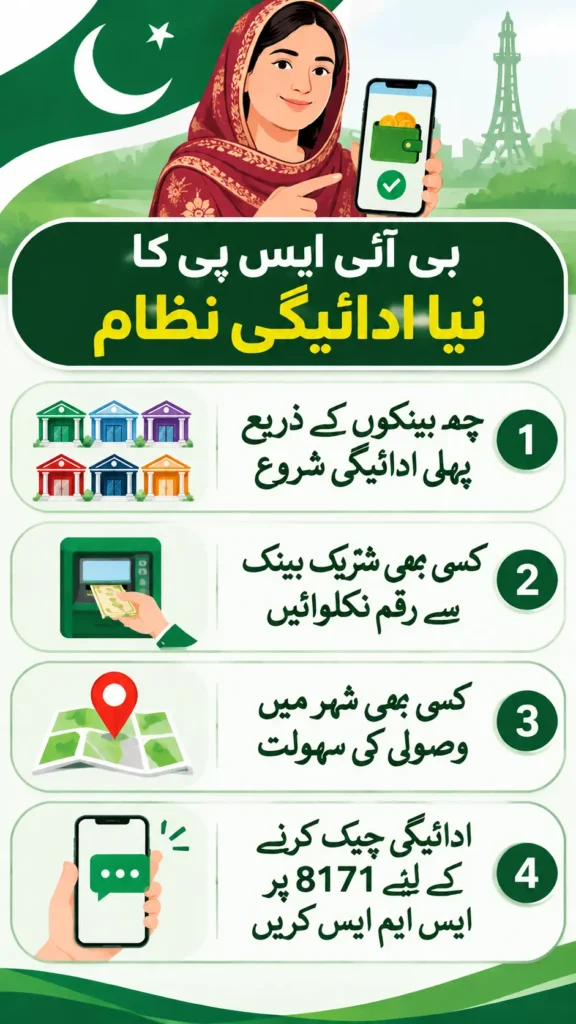
APP’s 12 November report identifies six financial institutions participating in the new BISP payment arrangement.
| No. | Participating bank or institution |
|---|---|
| 1 | Habib Bank Limited (HBL) |
| 2 | HBL Microfinance Bank |
| 3 | Easypaisa |
| 4 | JazzCash |
| 5 | Bank Alfalah |
| 6 | Bank of Punjab |
These institutions are also consistent with the participating organisations identified in BISP’s original June 2026 agreement record.
The purpose of bringing multiple financial institutions into one interoperable arrangement is to give beneficiaries more withdrawal options. Instead of depending entirely on the network of the institution that originally credited the assistance, women are intended to access authorised retailers of other participating institutions.
However, beneficiaries should check the availability of an authorised payment retailer before travelling. The system’s design does not guarantee that every branch, shop or agent can process every transaction.
What Is the BISP Interoperable Payment System?
An interoperable payment system allows different participating financial institutions to work together so customers can access their funds across more than one payment network.
For BISP beneficiaries, the basic idea is straightforward: their financial assistance is credited to their personal Social Protection Wallet, and they are intended to be able to withdraw it through an authorised retailer of any participating institution.
For example, if a beneficiary’s payment is credited through one participating institution, she is not necessarily restricted to that institution’s withdrawal network. She can approach an authorised retailer of another participating partner, subject to the system’s operational availability and required verification.
How Does the New Payment Arrangement Work?
The documented digital-wallet process can be understood through these steps:
- Payment transfer: BISP transfers the beneficiary’s assistance into her personal digital wallet.
- SMS notification: BISP’s documented procedure includes a message informing the beneficiary when funds are credited.
- Visit an authorised retailer: The beneficiary approaches an authorised retailer of a participating financial institution.
- Identity verification: She presents her original CNIC and completes the required biometric verification.
- Withdrawal: After successful verification and transaction processing, she can withdraw the available assistance.
BISP’s July 2026 guidance also documents free Benazir SIM distribution linked to personal Social Protection Wallets.
The arrangement is intended to make payment collection easier, but beneficiaries should use authorised payment points and follow official instructions.
What Is the Difference Between the Old and New Payment Arrangements?
The main difference is the flexibility offered through participating financial institutions.
| Older bank-specific arrangement | Interoperable payment arrangement |
|---|---|
| Withdrawal could depend on a designated bank’s network. | Designed to allow withdrawals through participating institutions. |
| Beneficiaries had fewer payment-channel choices. | More participating withdrawal channels. |
| Payment collection could involve dependence on particular payment locations. | Intended to provide greater flexibility in choosing authorised retailers. |
| Limited flexibility between payment networks. | Greater cooperation between participating institutions. |
This comparison explains the intended change. It does not mean that every older payment method has already been replaced everywhere.
Background: How BISP Reached the Six-Bank Payment System
The November announcement is part of a wider BISP digital-wallet programme that developed over several months.
Here is the relevant timeline based on the available official documents and APP reporting.
| Date | Development |
|---|---|
| 18 June 2026 | BISP signed agreements with 1LINK and partner institutions to operationalise the interoperable digital-wallet system. |
| July 2026 | BISP documented free Benazir SIM distribution, wallet activation and payment verification arrangements. |
| 4 November 2026 | APP reported that BISP Chairperson Senator Rubina Khalid discussed digital wallets and interoperability during an E-Kachehri. |
| 12 November 2026 | APP reported the first disbursement through six participating institutions. |
| 13 November 2026 | The Nation published its report on the first interoperable payment launch. |
What Was Agreed With 1LINK in June 2026?
On 18 June 2026, BISP signed agreements with 1LINK and partner institutions to establish an interoperable digital-wallet payment arrangement.
According to BISP Press Release No. 50, the system was designed to credit assistance directly into beneficiaries’ digital wallets. Women would then be able to withdraw money through authorised retailers of participating institutions, regardless of which institution originally issued the payment.
The agreement was an important foundation for the November development.
What Did BISP Explain About Benazir SIMs?
In July 2026, BISP issued guidance about free Benazir SIMs and Social Protection Wallet activation.
The documented arrangement includes:
- Free Benazir SIM distribution through official BISP arrangements.
- Personal Social Protection Wallets for beneficiaries.
- Assistance with wallet activation.
- SMS notifications when payments are credited.
- Verification using the original CNIC and required biometric procedures.
Beneficiaries should obtain SIM-related services through official BISP channels rather than relying on unauthorised agents.
Rubina Khalid Meets SBP Governor Over Payment System Implementation
According to APP’s 12 November report, BISP Chairperson Senator Rubina Khalid met State Bank of Pakistan (SBP) Governor Jameel Ahmad to discuss the effective implementation of the interoperable payment system and its future direction.
BISP Additional Secretary Dr Ismat Nawaz also attended the meeting, according to the APP report.
During the meeting, Rubina Khalid reportedly acknowledged the State Bank’s guidance and support in developing the digital banking arrangement and bringing the six participating institutions into the system.
The meeting reflects the involvement of BISP and the central bank in the payment reform.
What Benefits Is the New BISP Payment System Designed to Provide?
BISP has described several objectives behind the interoperable payment arrangement. These are intended benefits, not proof that every payment location has already achieved them.
More Payment Choices for Women
The arrangement is designed to give beneficiaries more freedom to choose an authorised retailer from the participating institutions.
This could reduce dependence on a single payment network and provide more convenient withdrawal options for women.
Fewer Queues and Less Unnecessary Travel
BISP’s June agreement identifies reducing long queues, overcrowding and unnecessary travel as important objectives.
If more participating payment channels are available to beneficiaries, women may have greater flexibility in where and when they collect their payments.
Better Transparency and Accountability
Another stated objective is to improve the transparency of financial assistance delivery.
Digital wallet crediting and transaction notifications are intended to make payment handling more accountable.
Protection Against Unauthorised Deductions
BISP has also identified preventing unauthorised deductions as an objective of the digital-wallet arrangement.
Beneficiaries should still check the amount they receive and report any suspected deduction through official BISP channels.
Greater Financial Inclusion
Personal digital wallets are intended to give women greater access to formal financial services and more control over their financial assistance.
The long-term objective is to make payment delivery more accessible and dignified.
How Much Is the BISP Payment for October to December 2026?
The quarterly Benazir Kafaalat stipend rate is Rs14,500 for the October–December 2026 cycle, based on the increase confirmed by BISP in March 2026.
However, beneficiaries should understand an important distinction.
The APP report of 12 November and The Nation report of 13 November do not mention the amount of the first interoperable disbursement.
Therefore, Rs14,500 should not be described as the amount announced for the first payment under the six-bank system. It is the separately documented quarterly Kafaalat rate.
BISP Press Release No. 20, dated 10 March 2026, confirmed the increase in the quarterly stipend from Rs13,500 to Rs14,500.
For further information, readers can check our guide to the BISP November 2026 instalment.
How to Check Your BISP Payment Status Through Official Channels
Beneficiaries can use BISP’s established information channels to check their eligibility and payment-related information.
1. Check BISP Status Through SMS 8171
The SMS method is useful for beneficiaries who do not have regular internet access.
Follow these steps:
- Open the SMS application on your mobile phone.
- Enter your CNIC number.
- Send the message to 8171.
- Wait for the official response.
Remember that 8171 is BISP’s only official messaging number. Do not trust payment messages from unknown mobile numbers.
2. Check Through the 8171 Web Portal
Beneficiaries can use the official 8171 portal for eligibility and status information.
Official portal: https://8171.bisp.gov.pk/
Use the portal to follow the available instructions and check your BISP information.
Keep in mind that eligibility information and an actual wallet transaction are not necessarily the same thing. Do not assume that the portal will always display an immediate wallet balance or real-time transaction confirmation.
You can also read our separate guide on the BISP payment status check for 12 November 2026.
3. Contact the BISP Helpline
Beneficiaries who need assistance can contact the official BISP helpline:
0800-26477 (toll-free)
Use official BISP channels if you have questions about eligibility, payment notifications, wallet activation or a problem with your payment. Do not share your CNIC details, OTPs or wallet security information with unofficial agents or websites.
What Should Beneficiaries Carry When Collecting BISP Money?
Women collecting BISP assistance through an authorised retailer should follow the programme’s documented identity-verification procedure.
According to BISP’s Press Release No. 57, dated 15 July 2026, beneficiaries should have:
- Original CNIC: Carry your original Computerised National Identity Card for identity verification.
- Registered mobile number: Keep the relevant mobile number available for the documented verification procedure.
- Biometric verification: Complete the required biometric verification at the authorised payment location.
Before visiting a retailer, check that it is authorised by one of the participating institutions. Do not assume that every shop displaying a bank name can process BISP withdrawals.
BISP has also advised beneficiaries to protect their mobile phones during payment transactions. Do not hand over your phone or share private security information with an unauthorised person.
What Happens After the Payment Is Credited?
BISP’s documented digital-wallet procedure includes an SMS notification when financial assistance is transferred into a beneficiary’s wallet.
The beneficiary should check the message and confirm that it comes from the official BISP messaging number, 8171.
There is an important difference between receiving a payment notification and completing a cash withdrawal. An SMS confirming that funds have been credited does not necessarily mean that a withdrawal has already taken place.
If you receive a credit notification but face difficulty withdrawing the money, contact BISP through its official helpline or seek assistance through an authorised payment channel.
What Has Not Been Confirmed About the First Six-Bank Disbursement?
Although the November announcement is an important development, several details have not been provided in the launch reports.
Beneficiaries should avoid relying on social-media posts that announce unverified payment amounts, locations or completion dates.
| Important question | What is currently known |
|---|---|
| How much was paid in the first interoperable disbursement? | The APP and Nation launch reports do not specify an amount. |
| Which districts received the first payment? | No confirmed district-wise list was announced in the reviewed reports. |
| When will all districts receive payments? | No nationwide completion date was announced. |
| Can every bank branch or retailer process a withdrawal? | Universal availability has not been established. |
| Has the system completed implementation nationwide? | Complete nationwide implementation has not been independently confirmed. |
BISP’s wider payment arrangements have involved phase-wise releases, with payments communicated to beneficiaries as they become available. However, no specific district schedule for the first interoperable disbursement has been established.
The National Assembly committee record from July 2026 identified 31 December 2026 as a planned target for complete digitalisation and mandatory online functionality. This is a programme digitalisation target, not a confirmed nationwide payment completion date.
For beneficiaries, the safest approach is to check payment information through 8171 and follow official BISP instructions rather than travelling based on an unverified district announcement.
Frequently Asked Questions About the BISP Interoperable Payment System
1. What is the BISP interoperable payment system?
The BISP interoperable payment system is a digital-wallet arrangement designed to let beneficiaries withdraw their assistance through authorised retailers of participating financial institutions. It aims to reduce dependence on a single bank’s withdrawal network and give women more flexibility when collecting their payments.
2. Which six banks are included in the BISP payment system?
The six reported participating institutions are Habib Bank Limited (HBL), HBL Microfinance Bank, Easypaisa, JazzCash, Bank Alfalah and Bank of Punjab. This list comes from APP’s 12 November 2026 launch report and is consistent with the June 2026 BISP agreement record.
3. Can I withdraw my BISP money from any participating bank?
The system is designed to let beneficiaries withdraw through an authorised retailer of any participating institution, regardless of which bank originally credited their wallet. However, actual transaction availability depends on the retailer’s authorisation and operational status. Check availability before travelling.
4. Has BISP started the first payment through six banks?
APP reported on 12 November 2026 that BISP had started the first disbursement through six participating institutions. The Nation also reported the development on 13 November. No official BISP November launch press release was located during our verification.
5. How much is the BISP payment for October to December 2026?
The quarterly Benazir Kafaalat stipend rate is Rs14,500 for the October–December 2026 cycle, based on BISP’s March 2026 announcement. Beneficiaries should understand that this is the quarterly programme rate, not an amount announced for the first interoperable disbursement.
6. Was Rs14,500 the amount of the first interoperable payment?
No. The APP report of 12 November and The Nation report of 13 November do not mention the amount transferred in the first interoperable disbursement. Rs14,500 is the separately documented quarterly Benazir Kafaalat rate for the October–December 2026 cycle.
7. How can I check my BISP payment online?
Visit the official 8171 portal at https://8171.bisp.gov.pk/ and follow the available instructions. You can also send your CNIC number to 8171 through SMS. Remember that eligibility information and a live wallet transaction record are different things.
8. Which SMS number does BISP use for payment information?
8171 is BISP’s only official messaging number. Beneficiaries should be careful with messages received from other numbers, especially those promising immediate payments or asking for personal information, OTPs or money to release assistance.
9. What documents are needed to collect BISP money?
Beneficiaries should carry their original CNIC and follow the required mobile-number and biometric verification procedure at an authorised retailer. BISP’s July 2026 guidance documents these requirements. Use an authorised payment location rather than an unofficial agent.
10. Will all cities receive the new payment system at the same time?
There is no verified district-wise list or nationwide completion date for the first interoperable disbursement. The system is designed for wider access through participating institutions, but beneficiaries should check their own payment information before travelling to collect money.
11. Is the new BISP payment system intended to reduce unauthorised deductions?
Yes. Preventing unauthorised deductions is one of BISP’s stated objectives for the digital-wallet arrangement. However, this is an intended benefit, not evidence that every unauthorised deduction has already been eliminated. Beneficiaries should report suspected deductions through official BISP channels.
12. Is pakistanschemes.pk an official BISP website?
No. pakistanschemes.pk is an independent informational website and is not affiliated with BISP or the Government of Pakistan. It publishes explanatory guides to help readers understand government programmes. For personal eligibility, payment and registration matters, use official BISP channels.
Final Takeaway
BISP’s first interoperable payment disbursement through six participating institutions was reported by APP on 12 November 2026, with The Nation publishing further coverage on 13 November.
The new arrangement is designed to give women receiving Benazir Kafaalat assistance more flexibility by allowing withdrawals through authorised retailers of participating financial institutions. Its stated objectives include reducing queues, improving transparency, preventing unauthorised deductions and supporting women’s financial inclusion.
The six reported partners are HBL, HBL Microfinance Bank, Easypaisa, JazzCash, Bank Alfalah and Bank of Punjab.
For the October–December 2026 cycle, the quarterly Benazir Kafaalat rate is Rs14,500. However, this amount was not specified in the reports announcing the first interoperable disbursement.
Beneficiaries should check their information through 8171, use their original CNIC for authorised payment verification and follow official BISP instructions. No district list or nationwide completion date was announced for the first six-bank disbursement.
Official information matters: Do not rely on unverified social-media claims about payment amounts, district coverage or release dates.




2 thoughts on “BISP Launches First Payments Through Six Banks Under Interoperable System”