
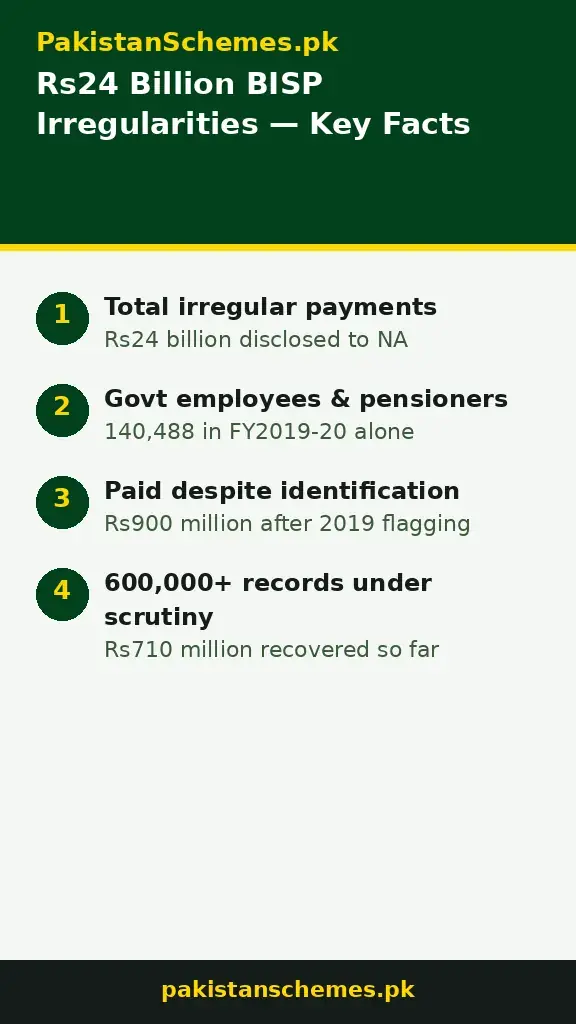
Irregularities of Rs24 billion have been uncovered in the Benazir Income Support Programme (BISP), with 140,488 government employees and pensioners found to have received payments meant for poor families. The figures come from documents the Ministry of Poverty Alleviation and Social Safety presented in the National Assembly — and they make uncomfortable reading: the problem was identified back in 2019, yet payments kept flowing for six more years.
According to the documents, government employees and pensioners drew Rs23.13 billion from BISP in the fiscal year 2019-20 alone. Another Rs900 million was paid out even after the employees had been identified. Against the Rs24 billion total, only about Rs710 million has been recovered so far.
These are the fullest figures the government has put before Parliament on the scale of BISP irregularities. They sit alongside a separate disclosure — reported on this site on 23 October — in which the minister confirmed that 229,157 government employees or their spouses had been identified as BISP beneficiaries, with Rs712.4 million recovered. This guide explains what today’s Rs24-billion disclosure adds, the year-by-year breakdown, what has been recovered, and what it means for genuine beneficiaries.
This is an independent informational guide based on the Poverty Alleviation Ministry’s documents presented in the National Assembly, as reported on Saturday, 24 October 2026 — not an official BISP announcement. The recovery and scrutiny exercise is ongoing, so figures may change. Verify your own beneficiary status only through official BISP channels (8171 SMS or bisp.gov.pk).
Quick Summary
| Topic | Details |
|---|---|
| Total irregularities disclosed | Rs24 billion in BISP payments to ineligible government employees and pensioners |
| Source of figures | Documents presented by the Ministry of Poverty Alleviation and Social Safety in the National Assembly, reported Saturday 24 October 2026 |
| Employees and pensioners identified | 140,488 (FY2019-20 audit records) |
| Largest single-year payout | Rs23.13 billion — FY2019-20 |
| Paid even after identification | Rs900 million (irregularities identified in 2019; payments continued six years) |
| Total recovered so far | Rs710 million — FIA Rs540m, other departments Rs145m, BISP staff Rs21.5m |
| BISP’s own staff involved | 236 employees received funds meant for poor beneficiaries |
| Next step | Records of over 600,000 government employees and pensioners to be scrutinised; records of involved employees forwarded to relevant departments |
| Status | Ongoing — recovery and scrutiny continue |
What the National Assembly documents reveal
The ministry’s documents describe a clean-up exercise that started with audit findings in 2019. In the fiscal year 2019-20, government employees and pensioners received Rs23.13 billion from BISP despite being ineligible — that is the single biggest chunk of the Rs24 billion total. A federal cabinet decision of 24 December 2019 had already excluded civil servants and their spouses from the programme, yet the money kept flowing.
The most striking part of the disclosure is the timeline. The irregularities were identified in 2019, but payments continued for six years afterwards. A further Rs900 million was paid out even after the employees concerned had been identified. Official records show that more than 12,000 employees received Rs146.7 million in 2020-21 alone — the financial year right after the cabinet decision barring them.
Year-by-year breakdown of the irregular payments
The documents provide a yearly trail of how many government employees kept receiving BISP funds after the 2019 identification. The numbers are worth reading in full because they show the problem never really stopped:
| Financial year | Employees identified | Amount paid |
|---|---|---|
| 2019-20 | 140,488 (employees and pensioners) | Rs23.13 billion |
| 2020-21 | More than 12,000 employees | Rs146.7 million |
| 2021-22 | 2,447 employees | Amount not specified in the documents |
| 2022-23 | 2,235 employees | Amount not specified in the documents |
| 2023-24 | 227 employees | Amount not specified in the documents |
| 2024-25 | 12,078 employees | Amount not specified in the documents (the FY25 audit separately reported Rs515.7 million to 12,078 employees, pensioners and spouses) |
| Also identified | 236 BISP employees | Funds meant for poor beneficiaries |
Two details stand out. First, the 2024-25 figure of 12,078 matches the Auditor General’s FY25 audit, which separately found that 12,078 government employees, pensioners or their spouses received Rs515.712 million in unconditional cash transfers — despite the December 2019 cabinet directive. Second, 236 BISP employees themselves were among those who received funds earmarked for poor beneficiaries — a fact that sharpens questions about the programme’s internal controls.
Only Rs710 million recovered against Rs24 billion
Recovery remains the weakest part of the story. Against the Rs24 billion in irregularities, the documents put total recoveries at just Rs710 million — under 3 percent of the amount:
| Recovered by | Amount |
|---|---|
| Federal Investigation Agency (FIA) | Rs540 million |
| Other government departments | Rs145 million |
| BISP, from its own employees | Rs21.5 million |
| Total | Rs710 million |
Note: in a separate written reply on 23 October, the poverty alleviation minister gave slightly different recovery figures (Rs545.784 million via the FIA, Rs21.550 million from BISP employees, Rs145.066 million from other departments — Rs712.4 million total). The two sets of figures come from different parliamentary disclosures and describe the same recovery drive at slightly different points; we have reported each as the minister and the minister’s ministry presented it.
The documents also record two concrete next steps. The records of employees allegedly involved in the irregularities have been forwarded to the relevant departments for further action — the same approach the minister described on 23 October, with cases referred to provincial chief secretaries, accountants general, the FIA and the Controller General of Accounts. And authorities have decided to scrutinise the records of more than 600,000 government employees and pensioners — the largest verification exercise of its kind against BISP rolls.
The wider clean-up: 2.25 million ineligible beneficiaries removed
The same ministry reporting that produced the Rs24-billion disclosure also confirmed the broader clean-up of BISP’s beneficiary rolls. Between 1 July 2025 and 30 June 2026, the government removed more than 2.25 million ineligible beneficiaries (2,259,404) from the programme, while payments to more than 800,000 people identified as ineligible were stopped.
The ministry also reported receiving 55,579 complaints during the previous fiscal year, relating to unauthorised deductions, embezzlement and unauthorised disbursement of funds. These figures show the irregular-employee issue is part of a much larger effort to re-verify who is actually on BISP’s rolls.
One note of honesty about the numbers: this site reported on 23 October that 229,157 government employees or their spouses had been identified in BISP’s latest Management Information System data. That figure and today’s 140,488 are not contradictory — they come from different datasets (the 140,488 is the 2019-20 audit figure for employees and pensioners; the 229,157 is the latest MIS figure including spouses). Both point the same way: hundreds of thousands of ineligible names were on the rolls, and the clean-up is still counting.
What this means for genuine BISP beneficiaries
If you are an eligible beneficiary, the disclosures do not change your entitlement — the irregularities were about ineligible people receiving money, not about the programme being withdrawn. What the episode does confirm is that BISP is re-verifying its records aggressively: 2.25 million ineligible beneficiaries were already removed this fiscal year, and 600,000-plus employee and pensioner records are now going under scrutiny. Keep your own record clean: ensure your CNIC details, mobile number and household information in the NSER/dynamic survey data are correct and up to date.
The episode also revives an old problem BISP recipients know well — fraudsters exploiting the news. Whenever BISP makes headlines, scam callers and fake “agents” appear, claiming they can secure your installment or “re-register” you for a fee. BISP has no online registration — enrolment happens only through the in-person NSER/dynamic survey at tehsil offices. Do not pay anyone, do not share your CNIC or OTP with callers claiming to be from BISP, and verify payment status only via the 8171 SMS service or bisp.gov.pk.
Frequently asked questions
What is the Rs24 billion BISP irregularities disclosure?
Documents presented by the Ministry of Poverty Alleviation and Social Safety in the National Assembly show that irregular payments of Rs24 billion went to ineligible government employees and pensioners under BISP — the bulk (Rs23.13 billion) in FY2019-20.
How many government employees were found taking BISP payments?
The 2019-20 audit identified 140,488 government employees and pensioners. The documents also give a yearly trail: more than 12,000 employees in 2020-21, 2,447 in 2021-22, 2,235 in 2022-23, 227 in 2023-24 and 12,078 in 2024-25. The latest MIS data separately put 229,157 employees or their spouses on the beneficiary rolls.
How much has been recovered?
About Rs710 million so far — Rs540 million through the FIA, Rs145 million from other government departments and Rs21.5 million from BISP’s own employees. A separate ministerial reply on 23 October put the recovery at Rs712.4 million with slightly different component figures.
Were BISP employees themselves involved?
Yes. The documents reveal that 236 BISP employees were among those who received funds meant for poor beneficiaries, and recovery has been initiated against them.
What happens next?
The records of the employees involved have been forwarded to the relevant departments for recovery and disciplinary action, and authorities have decided to scrutinise the records of more than 600,000 government employees and pensioners.
Does this affect payments to genuine BISP beneficiaries?
No official statement has suggested that eligible beneficiaries will lose their payments. The disclosures concern ineligible recipients being removed from the rolls. Genuine beneficiaries should keep their NSER records accurate and check status only through 8171 or bisp.gov.pk.
Summary: documents presented in the National Assembly on 24 October 2026 revealed Rs24 billion in BISP irregularities — 140,488 government employees and pensioners received funds meant for the poor, with Rs23.13 billion paid in 2019-20 alone and Rs900 million disbursed even after identification in 2019. Recoveries stand at about Rs710 million; records of over 600,000 employees and pensioners will now be scrutinised. Genuine beneficiaries should keep their records accurate and use only official BISP channels.
Disclaimer: This guide is based on parliamentary documents and media reporting of the National Assembly proceedings of 24 October 2026. It is informational, not official BISP guidance. Figures may be updated as the recovery and scrutiny exercise progresses. Always verify your beneficiary status and payments through 8171 SMS or bisp.gov.pk, and never pay agents claiming to register or “re-verify” you.