
On Tuesday, 3 November 2026, the Higher Education Commission (HEC) told the National Assembly Standing Committee on Federal Education and Professional Training that Pakistani universities global rankings have improved sharply over the past six years. The briefing was given by HEC Chairman Dr Niaz Ahmad Akhtar at the committee’s 27th meeting, held at the HEC Secretariat in Islamabad.
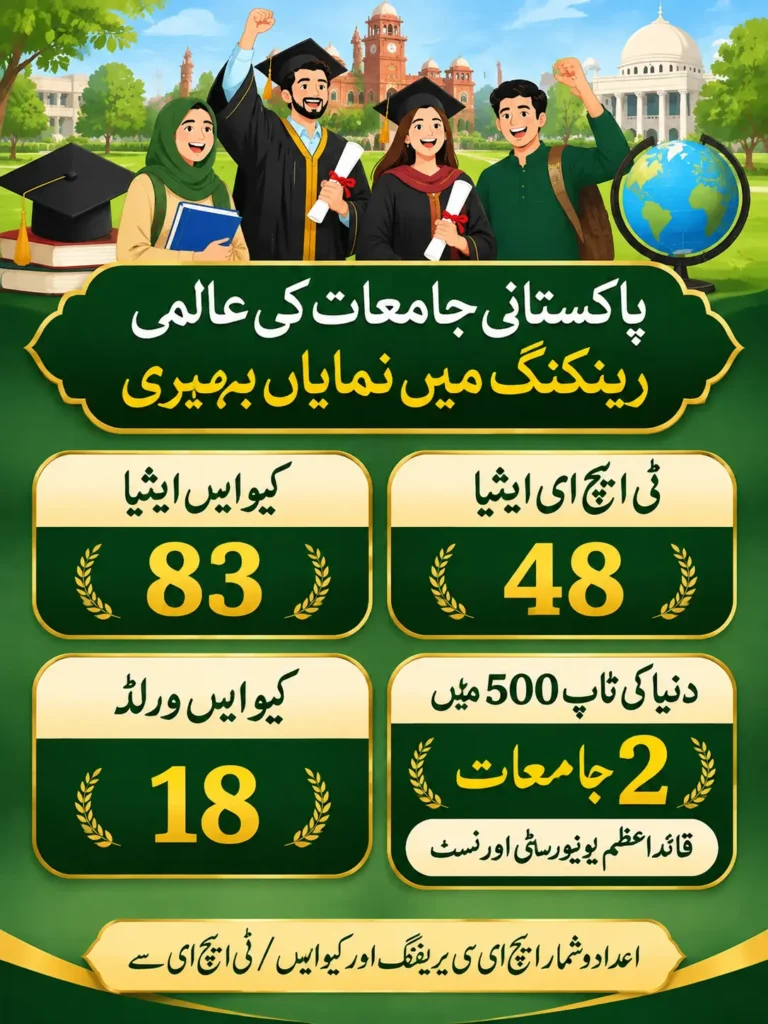
The headline figures are striking. HEC reported that the number of Pakistani universities in the QS Asia rankings has risen from 29 in 2020 to 83 in 2026. In the QS World University Rankings 2027, the number has risen from 7 in 2020 to 18, according to HEC, with two Pakistani universities — Quaid-i-Azam University (QAU) and the National University of Sciences and Technology (NUST) — now in the world’s top 500.
This article sets out what HEC reported, which figures are confirmed by the official QS and Times Higher Education (THE) websites, what the rankings actually measure, what HEC says it is doing next, and what the news means for students choosing a university.
HEC Rankings Briefing: Quick Summary
| Ranking | 2020 | Latest edition | Universities |
|---|---|---|---|
| QS Asia University Rankings | 29 | 2026 | 83 |
| THE Asia University Rankings | 14 | 2026 | 48 |
| THE World University Rankings | 14 | 2027 | 56* |
| QS World University Rankings | 7 | 2027 | 18* |
| QS World 2027 — in the world’s top 500 | — | 2027 | 2 |
| QS World 2027 — in the top 1,000 | — | 2027 | 12* |
| THE World 2026 — in the top 1,000 | — | 2026 | 22* |
* Figures marked with an asterisk are HEC-reported figures from the briefing. They could not be independently confirmed from the official QS or THE websites at the time of writing. They are therefore attributed to HEC in this article, not presented as independently verified totals. The individual ranks for QAU and NUST were confirmed against their official QS profiles.
Event: HEC briefing to the NA Standing Committee on Federal Education and Professional Training, 27th meeting, HEC Secretariat, Islamabad, 3 November 2026. Reported by: Daily Lead Pakistan, APP (via TezKhabar) and DNA News Agency, all on 3 November 2026. No HEC press release on the briefing was found on hec.gov.pk at the time of writing, and the reports do not name the committee chair, so no chair’s name is given here.
What HEC Reported About Pakistani Universities’ Global Rankings
According to the reports of the briefing, HEC presented a comparison across four international rankings. The figures below are the figures HEC reported to the committee. Where a figure could not be confirmed from the official QS or THE website, that is stated clearly.
| Ranking | 2020 | Latest | Change |
|---|---|---|---|
| QS Asia University Rankings | 29 | 83 (2026) | +54 |
| THE Asia University Rankings | 14 | 48 (2026) | +34 |
| THE World University Rankings | 14 | 56 (2027)* | +42 |
| QS World University Rankings | 7 | 18 (2027)* | +11 |
On the QS Asia figure, HEC’s total of 83 is the corrected total. QS initially listed 82 Pakistani universities in QS Asia 2026, then added GIK Institute at rank 260, bringing the total to 83. That correction is part of the HEC briefing, and the figure of 83 is used here.
The THE World 2027 total of 56 and the QS World 2027 total of 18 are HEC-reported. The 2027 edition of the THE World University Rankings is published, but the total of 56 Pakistani universities in it could not be independently confirmed from the THE website at the time of writing. Likewise, the QS World 2027 total of 18 could not be directly confirmed from topuniversities.com, although the QS 2027 Pakistan rankings page was checked. Both figures are therefore presented as reported by HEC to the committee, not as independently verified totals.
For the THE World 2026 top 1,000, HEC reported 22 Pakistani universities. Some independent trackers count 24. Counts can vary by source and methodology — for example, whether universities in tied bands or at the edge of a range are counted the same way — so neither 22 nor 24 should be treated as the single settled number without that note. This article uses HEC’s figure of 22, as HEC-reported.
QAU and NUST Enter the QS World Top 500
The strongest, independently confirmed part of the briefing is at the top of the QS World University Rankings 2027. Two Pakistani universities are in the world’s top 500: Quaid-i-Azam University (QAU), ranked =381, and the National University of Sciences and Technology (NUST), ranked 384. Both ranks were confirmed against their official QS profiles.
HEC also reported that 12 Pakistani universities are in the QS World 2027 top 1,000. That count is HEC-reported. The full list of 12, with names and ranks, could not be verified from the official QS website, so no list is given here. Readers should check the official QS rankings for the full list rather than relying on an unverified one.
QAU and NUST have long been Pakistan’s leading universities in international rankings, and their positions in the top 500 are a milestone for the country’s higher education sector. They are the two universities that give Pakistan a presence in the top 500 of the QS World Rankings 2027.
What Do QS and THE Rankings Measure, and Why Does HEC Care?
It is important to be clear about what these rankings are. QS and THE are international ranking organisations. They are not HEC rankings, and HEC does not produce them. HEC reported the counts to the committee; QS and THE produce the rankings themselves.
According to the briefing, the chairman said the rankings indicate global visibility, academic reputation, research performance, graduate employability and international engagement. Those are the areas QS and THE measure, in different ways and with different weightings, through academic surveys, employer surveys, citations and research output, international staff and students, and other indicators.
He also made a point that matters for how readers should interpret the news: the objective is sustainable improvement in academic quality, not ranking positions alone. A rise in the number of ranked universities is a sign of progress, but it is not the same as an improvement in teaching, research or graduate outcomes in every university. Rankings reward visibility and research output, and they can move when more universities take part, when data improves, or when methodologies change.
That is why the comparison over time is useful, but should be read with care. The increase from 29 to 83 in QS Asia and from 7 to 18 in the QS World rankings, as reported by HEC, shows that more Pakistani universities are now visible in international rankings than in 2020. It does not, on its own, prove that every one of those universities has improved in quality by the same amount.
What Is HEC Doing to Improve University Performance?
HEC told the committee it has constituted a Ranking Committee to develop a coordinated national approach to rankings. The committee’s role is to familiarise institutions with ranking methodologies and to guide them on performance gaps, so that universities understand what the rankings measure and where they need to improve.
As part of that work, HEC’s Higher Education Data Repository (HEDR) Division ran a one-day capacity-building session on the QS methodology for committee members. The session was reported by The Global Times on 22 October 2026 — not on 3 November — and involved the Director General of HEDR, Syed Naveed Hussain Shah, and National Coordinator Muhammad Ali Baig, with technical sessions by Engr. Dr Ghulam Mustafa of PIEAS and Engr. Usama Rashed of NUST.
HEC also briefed the committee on wider reforms. About 20 task forces have been set up for priority areas. Policy work is under way on undergraduate education, transnational education, liberal arts, dual, double and joint degrees, computing education, curriculum transformation and the integration of artificial intelligence (AI) into teaching and learning. HEC is also providing free-of-cost AI training for faculty and administrative staff.
On services for graduates, HEC briefed the committee on online and paperless degree attestation, developed in partnership with the Ministry of Foreign Affairs and the Inter Board Committee of Chairmen (IBCC). The aim is to make attestation faster and less dependent on paper files and in-person visits.
Scholarships and International Opportunities for Pakistani Students
The briefing also named the scholarships and partnerships HEC says are open to Pakistani students and researchers. These are existing programmes. No new scholarship, deadline, amount or application link was announced in this story, and none is invented here.
The programmes named were the Pak-US Knowledge Corridor, Fulbright, the German Academic Exchange Service (DAAD), the Quaid-i-Azam Memorial Scholarships, Stipendium Hungaricum, and the Allama Iqbal Scholarships for international students. HEC also named academic partnerships with Chinese institutions and technology companies, and the HEC Global Scholar Network Portal.
For readers who want details of the HEC scholarships already covered on this site, see our posts on the HEC US-Pakistan Knowledge Corridor PhD Scholarship 2027 and the HEC IRSIP Batch 60 2026 PhD Research Fellowship Abroad. Note that the Knowledge Corridor Spring/Summer 2026 deadline and the IRSIP Batch 60 window reported in those posts were in October 2026, so readers should check the posts and the official HEC website for current status before applying. Always apply through the official HEC channels named in those posts, not through any link in this rankings article.
Students interested in studying abroad should also check the official QS and THE ranking pages for the universities they are considering, and the official scholarship pages for eligibility, deadlines and required documents. A university’s rank is only one factor; the course, the supervisor, the funding and the living costs matter at least as much.
Challenges Pakistani Universities Still Face
The briefing did not present the rankings as a complete success story. HEC also named the challenges that hold Pakistani universities back, according to the reports: financial and budgetary constraints, geopolitical and internationalisation barriers, limited global recognition, and insufficient industry engagement.
Those challenges help explain why the number of ranked universities has risen faster than Pakistan’s presence at the very top of the rankings. Funding limits affect research, laboratories, libraries and the ability to attract and keep faculty. Internationalisation barriers affect student and staff mobility, joint research and the international outlook that QS and THE reward. Limited industry engagement affects graduate employability and the link between university research and the economy.
HEC’s reforms — the Ranking Committee, the task forces, the curriculum and AI work, and the paperless attestation system — are presented as a response to those challenges. Whether they close the gap will be judged in future ranking editions and, more importantly, in teaching, research and graduate outcomes.
What Do These Rankings Mean for Students Choosing a University?
For students and parents, the rankings are a useful starting point, not a final answer. A university in the QS or THE rankings has met a minimum level of international visibility and research activity. A university in the top 500, like QAU and NUST in QS World 2027, is recognised internationally at a higher level.
But students should also look at the subject rankings for their own field, the department’s faculty and research, the university’s facilities, the cost and location, and the outcomes of recent graduates. A university ranked lower overall may be strong in a particular subject. A university that is not ranked at all may still be a good choice for a particular course, especially at undergraduate level.
Students should also be careful about claims that use rankings to sell admissions. Check the rank on the official QS website at topuniversities.com or the official THE website at timeshighereducation.com, check the edition and the year, and check whether the rank quoted is for the university as a whole or for a subject. Do not rely on social media posts or agents who quote a rank without a source.
Frequently Asked Questions
Is this HEC’s own ranking?
No. These are international rankings produced by QS (Quacquarelli Symonds) and Times Higher Education (THE). HEC reported the numbers of Pakistani universities in those rankings to the National Assembly committee. HEC does not rank universities itself in this story, and this article never calls it an HEC ranking.
Which Pakistani universities are in the world’s top 500?
Quaid-i-Azam University (QAU), ranked =381, and the National University of Sciences and Technology (NUST), ranked 384, in the QS World University Rankings 2027. Both ranks were confirmed against their official QS profiles.
How many Pakistani universities are in the QS World University Rankings 2027?
HEC reported 18, up from 7 in 2020. That total is HEC-reported and could not be independently confirmed from topuniversities.com at the time of writing.
How many are in the THE World University Rankings 2027?
HEC reported 56, up from 14 in 2020. That total is also HEC-reported and could not be independently confirmed from the THE website at the time of writing.
Where can I check the official rankings?
On the QS website at topuniversities.com and the THE website at timeshighereducation.com. Check the ranking, the edition and the year, and whether the figure is for the university as a whole or for a subject.
How can students benefit from these rankings?
Use them as a starting point for choosing a university or a subject, and combine them with the course details, fees, scholarships and graduate outcomes. The scholarships named in the briefing — including the Pak-US Knowledge Corridor, Fulbright, DAAD, Quaid-i-Azam Memorial Scholarships, Stipendium Hungaricum and Allama Iqbal Scholarships — are existing programmes; check their official pages for current eligibility and deadlines. No new scholarship was announced in this briefing.
Conclusion
HEC’s briefing to the National Assembly committee on 3 November 2026 shows that Pakistani universities are more visible in global rankings than they were in 2020, with 83 universities in QS Asia 2026 and, as reported by HEC, 18 in the QS World Rankings 2027 and 56 in the THE World Rankings 2027. Two universities, QAU and NUST, are in the QS World top 500, with ranks of =381 and 384 confirmed by QS.
The rise is real, but it is not the whole story. HEC itself says the goal is sustainable academic quality, not ranking positions alone, and it names funding, internationalisation and industry engagement as continuing challenges. For students, the rankings are a helpful guide — but the course, the department and the funding matter just as much as the number.
Disclaimer
Figures marked as HEC-reported in this article are taken from media reports of HEC’s briefing to the National Assembly Standing Committee on 3 November 2026 and have not been independently confirmed from the official QS or THE websites, as noted in the article. Totals can vary by source and methodology, and rankings change with each new edition. Readers should verify ranks, deadlines and scholarship details on the official HEC, QS and THE websites before making decisions. This article is for information only and is not an official HEC announcement.
Sources
Daily Lead Pakistan — HEC’s achievements in global rankings highlighted, 3 November 2026: dailyleadpakistan.com · DNA News Agency — HEC’s achievements in global rankings highlighted, 3 November 2026: dnanews.com.pk · APP via TezKhabar — HEC chairman highlights Pakistan’s global rankings growth in higher education, 3 November 2026: tezkhabar.com · The Global Times — HEC organizes one-day session on QS World University Rankings methodology, 22 October 2026: theglobaltimes.com.pk · QS World University Rankings 2027 — Pakistan: topuniversities.com · QAU QS profile: topuniversities.com · NUST QS profile: topuniversities.com · THE World University Rankings 2026 — Pakistan: timeshighereducation.com