At a Glance
| Key information | Details |
|---|---|
| Senate meeting | 23 November 2026 |
| Committee chair | Senator Barrister Zamir Hussain Ghumro |
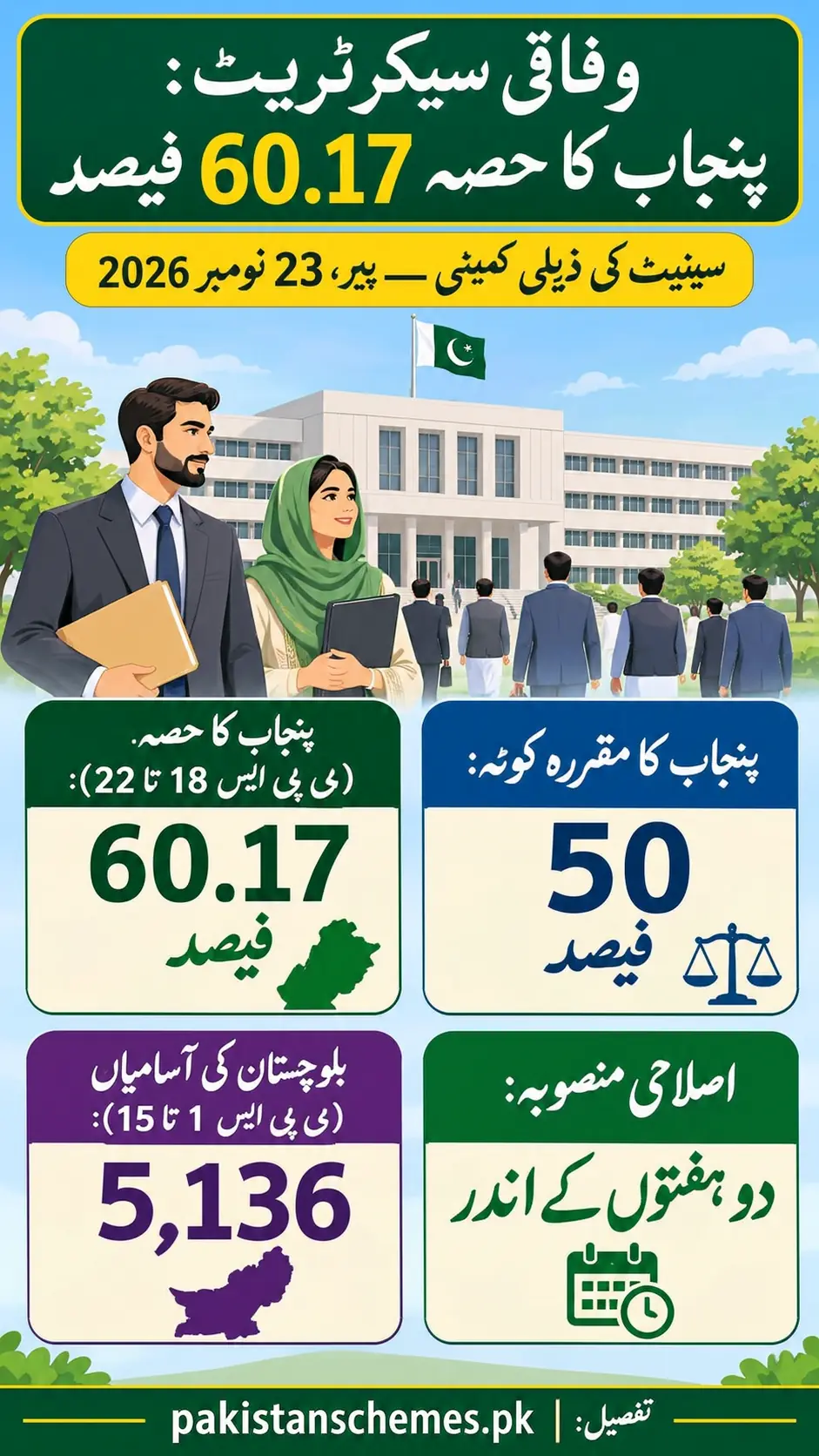
| Punjab’s reported share | 60.17% |
| Posts covered | BPS 18–22 |
| Data period | 2025–26 |
| Rectification plan | Within two weeks |
| Balochistan vacancies | 5,136 advertised posts |
| Employment opportunities for Balochistan | 200,000 planned |
Punjab holds 60.17% of senior Federal Secretariat positions in BPS 18–22, according to domicile-wise data for 2025–26 presented to the Senate subcommittee on 23 November 2026.
The meeting was chaired by Senator Barrister Zamir Hussain Ghumro, with Senators Jan Muhammad Buledi and Poonjo Bheel in attendance.
The Punjab 60.17% senior federal posts Senate development is particularly important for job seekers from Sindh and Balochistan. The committee also raised concerns about provincial representation and demanded a comprehensive rectification plan within two weeks.
Punjab Holds 60.17% of Senior Federal Posts, Senate Told
The Establishment Division presented domicile-wise information covering Federal Secretariat employees in BPS 18–22.
According to the figures presented during the meeting, Punjab accounted for 60.17% of these senior positions in 2025–26.
The committee expressed concern about provincial representation in federal employment and called for immediate rectification.
Details of the 60.17% finding
| Detail | Reported information |
|---|---|
| Punjab’s representation | 60.17% |
| Employee grades | BPS 18–22 |
| Positions covered | Federal Secretariat |
| Data period | 2025–26 |
| Data provider | Establishment Division |
| Data classification | Domicile-wise |
| Meeting date | 23 November 2026 |
The 60.17% figure relates to reported representation in senior Federal Secretariat positions. It shows that Punjab held more than three in every five of these posts, according to the domicile-wise data presented.
What Is the Provincial Quota in Federal Government Jobs?
Pakistan has a prescribed quota formula for direct recruitment in federal government services. It allocates a specific share to each province and region.
The Establishment Division’s quota policy provides the following distribution:
Prescribed Provincial Direct-Recruitment Shares
| Province or region | Prescribed share |
|---|---|
| Punjab, including Islamabad Capital Territory | 50% |
| Sindh | 19% |
| Khyber Pakhtunkhwa | 11.5% |
| Balochistan | 6% |
| Gilgit-Baltistan | 1% |
| Newly merged districts / former FATA | 3% |
| Azad Jammu and Kashmir | 2% |
| Merit | 7.5% |
| Total | 100% |
These percentages represent prescribed direct-recruitment shares. They are not a breakdown of the current representation in BPS 18–22.
The Senate discussion focused on ensuring that provincial representation in federal services follows the prescribed shares.
What Did the Senate Subcommittee Direct?
The Senate Standing Committee on Devolution’s subcommittee discussed provincial representation and recruitment during its meeting in Islamabad.
Senator Barrister Zamir Hussain Ghumro chaired the meeting. Senators Jan Muhammad Buledi and Poonjo Bheel also attended.
The committee gave several directions to the Establishment Division and FPSC.
Main Directions Given by the Senate Subcommittee
| Issue | Direction |
|---|---|
| Provincial representation | Immediate rectification |
| Rectification plan | Submit a comprehensive plan within two weeks |
| Lower-grade positions | Include BPS 1–15 |
| Appointments | Initiate the appointment process forthwith |
| Sindh’s quota | End the rural-urban division for provincial-share purposes |
| FPSC information | Provide vacancy and appointment details for Sindh and Balochistan |
| Recruitment advertisements | Ensure transparent and impartial recruitment |
| Provincial shares | Follow prescribed provincial shares |
Establishment Division Asked to Correct Previous Omissions
The subcommittee expressed displeasure over the Establishment Division’s failure to submit a rectification plan for Sindh as directed in earlier meetings.
The committee wanted the department to address provincial representation through a comprehensive plan covering BPS 1–15.
It also directed the Establishment Division to review and revise recruitment rules.
The department assured the committee that rectification would be taken up and that posts representing Sindh’s share would be initiated through advertisements.
However, this assurance does not mean that all required changes have already been implemented.
Sindh’s Rural and Urban Division
The committee specifically directed that Sindh’s rural and urban division should end for provincial-share purposes.
It wanted Sindh to receive consideration as a whole province, similar to the treatment of other provinces.
This was a direction issued during the meeting. It should not be interpreted as confirmation that the division has already been removed from recruitment rules.
FPSC Asked to Provide Vacancy Details
The Federal Public Service Commission was directed to provide information about vacant positions and appointments from Sindh and Balochistan.
The committee also stressed that recruitment should follow the prescribed provincial shares.
This information is important because job seekers need to understand whether recruitment opportunities are being shared fairly among provinces.
The Senate did not announce a specific number of additional FPSC vacancies during this meeting.
Why Article 38(g) Matters for Federal Government Jobs
Article 38(g) of Pakistan’s Constitution is relevant to the discussion about provincial representation in federal employment.
In simple words, it requires the State to secure provincial shares in federal services, including autonomous bodies and corporations established under federal government control.
It also provides for rectification of past omissions in provincial allocations.
The constitutional provision is intended to ensure that employment opportunities in federal institutions are shared fairly among provinces.
The Senate subcommittee referred to Article 38(g) while discussing the Establishment Division’s domicile-wise data.
The committee demanded that constitutional provincial shares be followed and that earlier gaps in representation be corrected.
It is worth understanding that Article 38(g) falls under the Constitution’s Principles of Policy. It guides the State’s responsibilities rather than creating a directly enforceable right in the same way as a fundamental right.
What Does This Decision Mean for Job Seekers?
The Senate discussion has implications for candidates interested in federal government employment, particularly those from provinces with lower representation.
However, the committee’s directions do not automatically guarantee new vacancies or appointments for individual candidates.
Here is what job seekers should understand.
Impact on Job Seekers by Province
| Province | Relevant development | What applicants should know |
|---|---|---|
| Sindh | Rural-urban division directed to end for provincial-share purposes | Watch for future federal recruitment advertisements and updates |
| Balochistan | 5,136 BPS 1–15 posts recently advertised | Check the actual advertisements and eligibility conditions |
| Punjab | 60.17% reported representation in BPS 18–22 | The committee has demanded rectification of provincial representation |
| Khyber Pakhtunkhwa | Provincial share included in the federal recruitment quota | Follow official federal recruitment advertisements and eligibility requirements |
For candidates from Sindh, the committee’s direction concerning the rural-urban division is an important development.
Applicants from Balochistan can also follow the advertised federal vacancies and subsequent recruitment announcements.
Candidates from Punjab and Khyber Pakhtunkhwa should continue checking the official recruitment notices issued by FPSC and federal departments.
Balochistan’s 5,136 Federal Vacancies and 200,000 Employment Plan
Balochistan was another important subject during the Senate subcommittee meeting.
The Establishment Division informed the committee that 5,136 posts in BPS 1–15 had recently been advertised for Balochistan.
It also discussed federal cabinet exemptions intended to facilitate applicants from Balochistan.
What About the 200,000 Employment Opportunities?
The Establishment Division also informed the committee about a plan to create 200,000 employment opportunities for Balochistan.
This figure needs to be understood correctly.
The 200,000 opportunities are part of an employment plan described to the Senate committee. They are not advertised vacancies.
The two figures represent different developments:
| Information | Status |
|---|---|
| 5,136 BPS 1–15 posts | Recently advertised |
| 200,000 employment opportunities | Planned opportunities for Balochistan |
Candidates should check the relevant official advertisements for application dates, qualifications, eligibility and other conditions.
The Senate meeting did not provide a complete list of the 5,136 vacancies or announce individual application deadlines.
Senate Also Raises Oil and Gas Revenue-Sharing Issue
Apart from federal employment, the subcommittee discussed the distribution of oil and gas revenues between the federation and the provinces.
The discussion involved Article 172(3) of Pakistan’s Constitution.
What Is Article 172(3)?
Article 172(3) provides for joint and equal ownership of mineral oil and natural gas within a province by the provincial government and the federal government.
Senator Ghumro referred to the passage of 16 years since the 18th Constitutional Amendment and criticised the delay in implementing the provision.
Senator Ghumro’s Rs3.6 Trillion Claim
During the proceedings, Senator Ghumro cited Rs3.6 trillion in profits from four oil and gas companies after the 18th Amendment.
The figure excluded SSGC, Sui Northern and other corporations.
He also estimated that the total could exceed Rs6 trillion when information from additional companies is included.
These amounts were claims and estimates cited during the Senate proceedings. They should not be treated as audited figures.
The committee directed the Petroleum Ministry to develop a mechanism for equal profit-sharing, submit a report within two weeks and establish a monitoring system.
This discussion was a separate development from the main issue of provincial representation in federal employment.
What Happens Next? Senate’s Two-Week Rectification Deadline
The Establishment Division now faces the task of preparing the comprehensive rectification plan demanded by the Senate subcommittee.
The plan is expected to address provincial representation in federal employment, including positions in BPS 1–15.
The committee also directed the appointment process to begin forthwith.
FPSC must provide the requested information about vacancies and appointments from Sindh and Balochistan.
When Is the Two-Week Deadline?
The Senate subcommittee met on Monday, 23 November 2026, and demanded submission of the rectification plan within two weeks.
Calculated indicative date: 7 December 2026 — fourteen calendar days after the 23 November meeting.
The Senate announcement specified a two-week period. It did not separately announce 7 December as a specific date.
The Establishment Division has assured the committee that rectification will be taken up.
The next important development will be whether the department submits its plan and starts the required appointment process.
Job seekers should continue following official FPSC advertisements and relevant government announcements.
Frequently Asked Questions
1. What does Punjab’s 60.17% share in senior federal posts mean?
It means that Punjab accounted for 60.17% of the senior Federal Secretariat positions in BPS 18–22, according to Establishment Division domicile-wise data for 2025–26 presented to the Senate subcommittee.
2. Which federal government posts are covered by the 60.17% figure?
The figure covers senior Federal Secretariat positions in BPS 18–22. It was based on domicile-wise employee information presented by the Establishment Division during the Senate meeting on 23 November 2026.
3. What is Article 38(g) of Pakistan’s Constitution?
Article 38(g) concerns securing provincial shares in federal services, autonomous bodies and corporations established under federal government control. It also provides for correcting past omissions in provincial allocations.
4. What did the Senate committee demand within two weeks?
The committee directed the Establishment Division to submit a comprehensive rectification plan covering federal positions, including BPS 1–15. It also directed that the appointment process begin forthwith.
5. What are the 5,136 Balochistan federal jobs?
The Establishment Division informed the Senate committee that 5,136 BPS 1–15 posts had recently been advertised for Balochistan. Applicants should check the relevant official recruitment advertisements for eligibility and application instructions.
6. How can job seekers check FPSC vacancies?
Candidates can visit the official Federal Public Service Commission website at fpsc.gov.pk. They should review the latest advertisements, check their qualifications and eligibility, and follow the application procedure and deadlines mentioned in each notice.
Conclusion
The Senate subcommittee’s discussion has brought attention to provincial representation in federal government jobs, particularly the reported 60.17% share held by Punjab in senior Federal Secretariat positions.
For people following the Punjab 60.17% senior federal posts Senate development, the next important step will be the Establishment Division’s rectification plan and the information requested from FPSC.
Sources: Dawn (24 November 2026); Senate of Pakistan official meeting report (23 November 2026).