The BISP audit 2024-25 has drawn fresh attention after a report published on 2 November 2026 highlighted a set of serious audit findings, including Rs130 million in scholarship payments that were reportedly made into benami accounts linked to five major universities.
However, the audit findings were not entirely new. The News had already reported in June 2026 that the Auditor General of Pakistan’s audit of BISP for financial year 2024-25 had identified more than Rs25 billion in financial exposure across 601,850 compromised cases. The November report added new details, including the scholarship allegation, rather than revealing the audit for the first time.
This article explains what has been reported, which figures have stronger supporting coverage and what remains unclear. It also explains what the findings mean for ordinary BISP beneficiaries, and how to avoid the scams that often follow this kind of news.
Quick Summary
| Detail | What has been reported |
| Audit period | Financial year 2024-25 |
| June report | The News, 24 June 2026 |
| November report | TechJuice, 2 November 2026 |
| Overall financial exposure | More than Rs25 billion |
| Compromised cases | 601,850, according to The News |
| Missing spouse CNIC records | 596,252, involving Rs25,459.960 million |
| Scholarship allegation | Rs130 million in benami accounts, reportedly linked to five universities |
| PMT-related misallocation | Rs533.536 million |
| Payments to 7,020 women | Rs104.734 million |
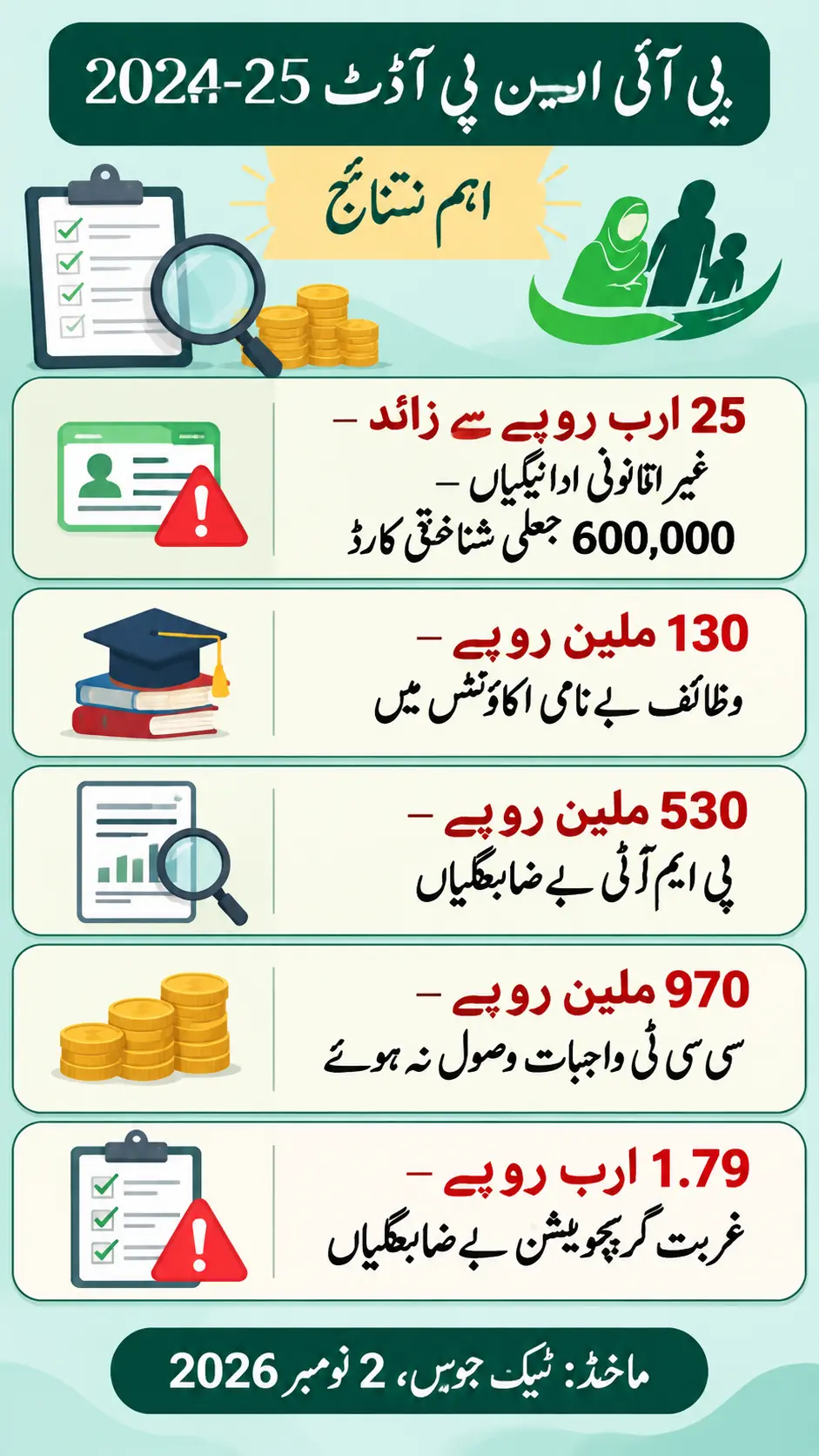
| CCT dues | Rs970 million reportedly unrecovered, according to TechJuice |
| Poverty Graduation | Rs1.79 billion in reported irregularities, according to TechJuice |
The figures describe audit observations or media-reported allegations. They do not mean that every amount was lost or that every beneficiary was ineligible.
What Is New in November — and What Was Already Reported in June
The News published detailed reporting on the FY2024-25 BISP audit on 24 June 2026. It described more than Rs25 billion in financial exposure, 601,850 compromised cases, and weaknesses in spouse CNIC records, the Proxy Means Test and scholarship payments.
TechJuice published another report on 2 November 2026. It repeated the broad Rs25 billion issue but added findings that had not appeared in the June article. The audit report itself was listed in the Auditor General of Pakistan’s catalogue as the BISP Audit Year 2025-26 report, published on 23 October 2026, which corresponds to the FY2024-25 audit cycle.
The main additional claims in the November report were Rs130 million in scholarship payments allegedly made into benami accounts, Rs970 million in unrecovered CCT dues, Rs1.79 billion in Poverty Graduation irregularities and questions about WHO and UNICEF agreements worth billions of rupees.
These should be treated as additional publicly reported findings, not proof that every issue was first discovered in November. Some may have been present in the audit all along but were not included in the June coverage.
The Main Audit Findings in Detail
The following table separates detailed figures reported in June from the additional claims reported in November.
| Audit issue | Reported figure | Source and status |
| Overall financial exposure | More than Rs25bn | The News, June 24 |
| Compromised cases | 601,850 | The News, June 24 |
| Missing spouse CNIC records | 596,252 cases | The News, June 24 |
| Payments linked to missing spouse CNIC records | Rs25,459.960m | The News, June 24 |
| PMT-related estimated misallocation | Rs533.536m | The News, June 24 |
| Women with incorrect marital-status records | 7,020 | The News, June 24 |
| Payments involving those women | Rs104.734m | The News, June 24 |
| Scholarship payments into benami accounts | Rs130m | TechJuice, November 2; not independently confirmed |
| CCT dues reportedly unrecovered | Rs970m | TechJuice, November 2; not independently confirmed |
| Poverty Graduation irregularities | Rs1.79bn | TechJuice, November 2; not independently confirmed |
The June figures have more detailed supporting coverage. The November figures should be attributed to TechJuice and treated as reported allegations until the underlying audit paragraphs can be checked.
The Rs130 Million Scholarship Payments Into Benami Accounts
One of the most notable claims in the 2 November report concerns Rs130 million in scholarship payments that TechJuice says were made into benami accounts linked to five major universities. The report describes the payments as illegal, but does not explain which universities were involved, how many accounts received the money or how the payments were identified.
TechJuice reported the amount and the number of universities, but did not identify the institutions. The universities have not been named in the other reporting examined for this article, so this article does not name them either.
No independent confirmation of the exact Rs130 million allegation was located in the other reporting examined. That does not mean the allegation is false; it means readers should treat it as a single-source report for now.
Readers should therefore understand this as a media-reported audit allegation, not a final finding of fraud against any named person or institution.
What the Rs25 Billion Figure Really Means
The Rs25 billion figure needs careful explanation because different reports use different descriptions. The two descriptions are not identical, and the distinction matters.
The News reported more than Rs25 billion in financial exposure across 601,850 compromised cases. It explained that 596,252 beneficiaries were recorded without any spouse CNIC, involving payments of Rs25,459.960 million.
TechJuice used the wording that more than Rs25 billion in illegal payments were made against 600,000 bogus CNICs. That wording is stronger than the detailed June breakdown supports.
A missing spouse CNIC record is not automatically proof that the beneficiary’s own CNIC was fake. The June report also identified other data problems, including 5,558 cases in which one spouse CNIC was linked to several female beneficiaries, involving Rs239.035 million.
The more precise wording is that the audit reporting identified 601,850 compromised cases, including 596,252 beneficiaries without a recorded spouse CNIC. The phrase “600,000 bogus CNICs” should be understood as TechJuice’s description, not as a verified count of fake identity cards.
PMT, CCT and Other Findings
The Proxy Means Test, or PMT, is used to assess household poverty levels for programme eligibility. The June report said multiple PMT scores were recorded against the same household heads in 97,179 cases. This weakness was associated with 18,964 irregularly enrolled beneficiaries and estimated misallocation of Rs533.536 million.
TechJuice rounded the PMT figure to Rs530 million in its November report.
The June report also identified Rs104.734 million in payments involving 7,020 women whose marital status had been incorrectly recorded as married since 2017, although they were subsequently confirmed as unmarried. The November report rounded this amount to Rs100 million.
For Conditional Cash Transfers, TechJuice reported Rs970 million in dues that had not been recovered. No independent confirmation of that figure was located in the other reporting examined, and the report does not explain how much may since have been recovered.
TechJuice also reported Rs1.79 billion in Poverty Graduation irregularities. The exact transactions or programme activities behind that figure were not explained in the report examined.
The November report raised questions about agreements involving the World Health Organization (WHO) and UNICEF worth billions of rupees. It did not specify the individual agreements or their values. BISP has documented partnerships with international organisations, including a WHO agreement announced on 25 September 2024, but the audit report has not been checked to confirm whether that agreement is one of the agreements questioned.
How This Differs From the Older Rs24 Billion BISP Audit
The Rs24 billion BISP story reported in October 2026 is a separate disclosure and should not be combined with the FY2024-25 audit figures. It concerns a different set of findings.
The Express Tribune reported on 24 October 2026 that National Assembly disclosures concerned 140,488 government employees who had received BISP payments. The total reported irregularities were Rs24 billion, including Rs23.13 billion paid to government employees and pensioners during FY2019-20.
The FY2024-25 audit covered wider data and programme-control issues, including missing spouse CNIC records, PMT weaknesses, duplicate scholarship payments and questions about international agreements.
These are different disclosures. Adding Rs24 billion to the more than Rs25 billion figure would create a misleading total of about Rs49 billion. The two amounts come from different audits and different periods.
Related reading: Rs24 Billion BISP Irregularities: 140,488 Govt Employees Took Aid, NA Briefed
What This Means for Genuine BISP Beneficiaries
An audit observation does not automatically cancel the eligibility of every person receiving BISP assistance. The findings describe weaknesses in records and financial controls. They do not establish that all beneficiaries were ineligible.
If you receive BISP assistance, rely on official programme instructions. You can use the official 8171 SMS service or the BISP web portal to check your status. If you need help, visit a BISP Tehsil Office.
Do not rely on social media posts claiming that every beneficiary has been disqualified or that a new registration process is required. No such general instruction was contained in the reporting examined for this article.
Scam Warning
Fraudsters may use news about BISP audits to frighten beneficiaries or offer fake registration and payment services.
- Never pay an agent to check your BISP eligibility or release a payment.
- Never share your CNIC number, photographs, OTP or personal information with strangers on WhatsApp or social media.
- Do not click suspicious links claiming to be a new 8171 registration portal.
- Use official BISP channels and verify messages before acting.
- Remember that pakistanschemes.pk is an unofficial information website. It does not collect CNICs, register beneficiaries or release payments.
If someone asks for money in exchange for confirming your eligibility, treat it as a warning sign.
FAQs
Does the BISP audit 2024-25 mean all beneficiaries are disqualified?
No. The reported audit findings concern financial controls and beneficiary records. They do not establish that every beneficiary was ineligible or that all payments will stop.
Were Rs130 million in scholarships paid into benami accounts?
TechJuice reported this allegation on 2 November 2026 and linked the accounts to five universities. The report did not name the universities, and no independent confirmation of the exact amount was located in the other reporting examined.
Which five universities were involved?
The reports examined do not name the universities. Do not rely on social media lists or guesses.
Is the Rs25 billion figure related to 600,000 fake CNICs?
TechJuice used the phrase “600,000 bogus CNICs”. The News provided more detailed figures: 601,850 compromised cases, including 596,252 beneficiaries without a recorded spouse CNIC. A missing spouse record is not the same as a fake CNIC.
How can I check my BISP status?
Use the official 8171 SMS service or BISP web portal. You can also visit a BISP Tehsil Office for guidance.
Has BISP responded to the scholarship allegation?
No specific public BISP response to the Rs130 million scholarship allegation was located in the official material examined for this article. That does not mean BISP has refused to respond; it means no public response was found.
Sources
- The News – FY25 audit finds Rs25bn irregularities, data deficiencies in BISP, 24 June 2026
- TechJuice – BISP Audit Flags Scholarship Payments to Benami Accounts, Other Irregularities, 2 November 2026
- Express Tribune – NA apprised of Rs24b irregularities in BISP, 24 October 2026
- Auditor General of Pakistan – Audit Reports
- Benazir Income Support Programme – Official website
- WHO – BISP Nashonuma agreement announcement, 25 September 2024